A Season Full of Gold

Almost six years ago now, I moved to Georgia to pursue a job. Pretty wild to think how quick time can fly, and how every year brings its own unpredictabilities that can bring both challenge and joy to life. With that being said, I’m a believer that wherever you live, it is crucial to have a handful of consistent people and activities to look forward to in order to maintain internal peace. Since moving to Georgia, I can say with confidence that one thing each and every year keeps me amped up for 6 months: Carp Season.
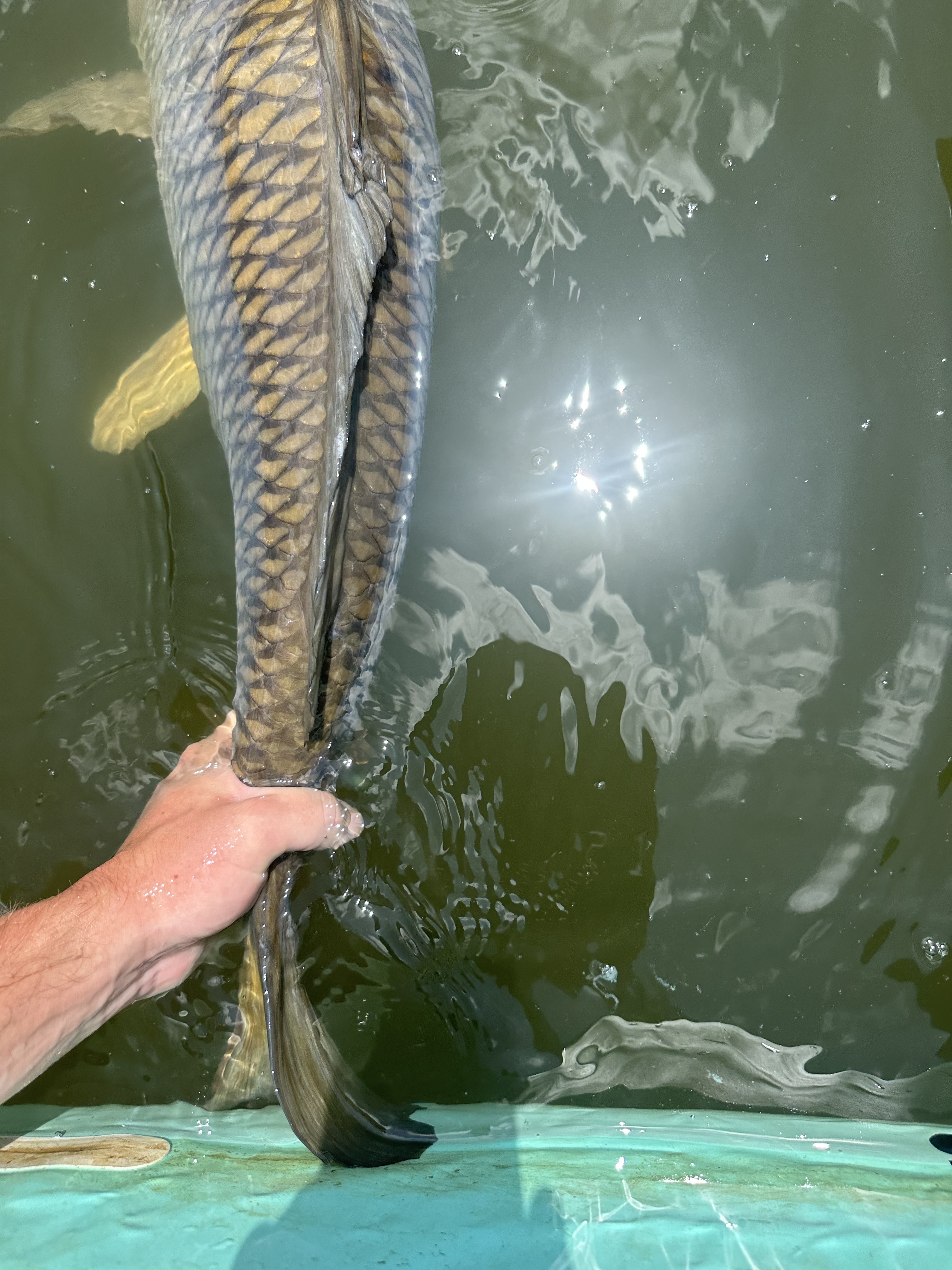
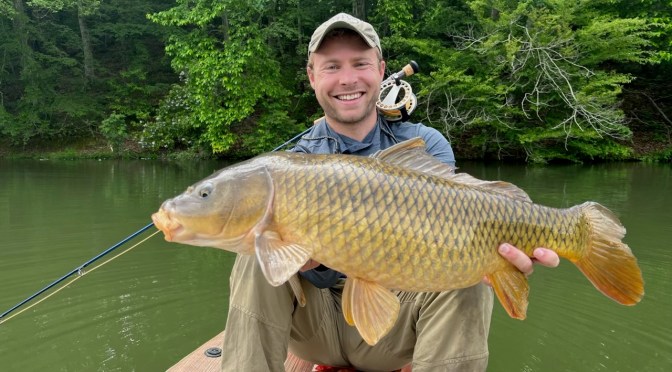
As those that are kind enough to follow this blog know, I’m a huge fan of the carp fishing opportunities in Georgia. I’ve fly fished for carp for nearly my entire life (and in countless places throughout the United States), and I can truly say that carping here is among the best. Not only can the numbers of carp here be unparalleled, but the sheer size of some of these fish is insanee. To emphasize further, the largest carp that I have seen in my entire life have been in Georgia.

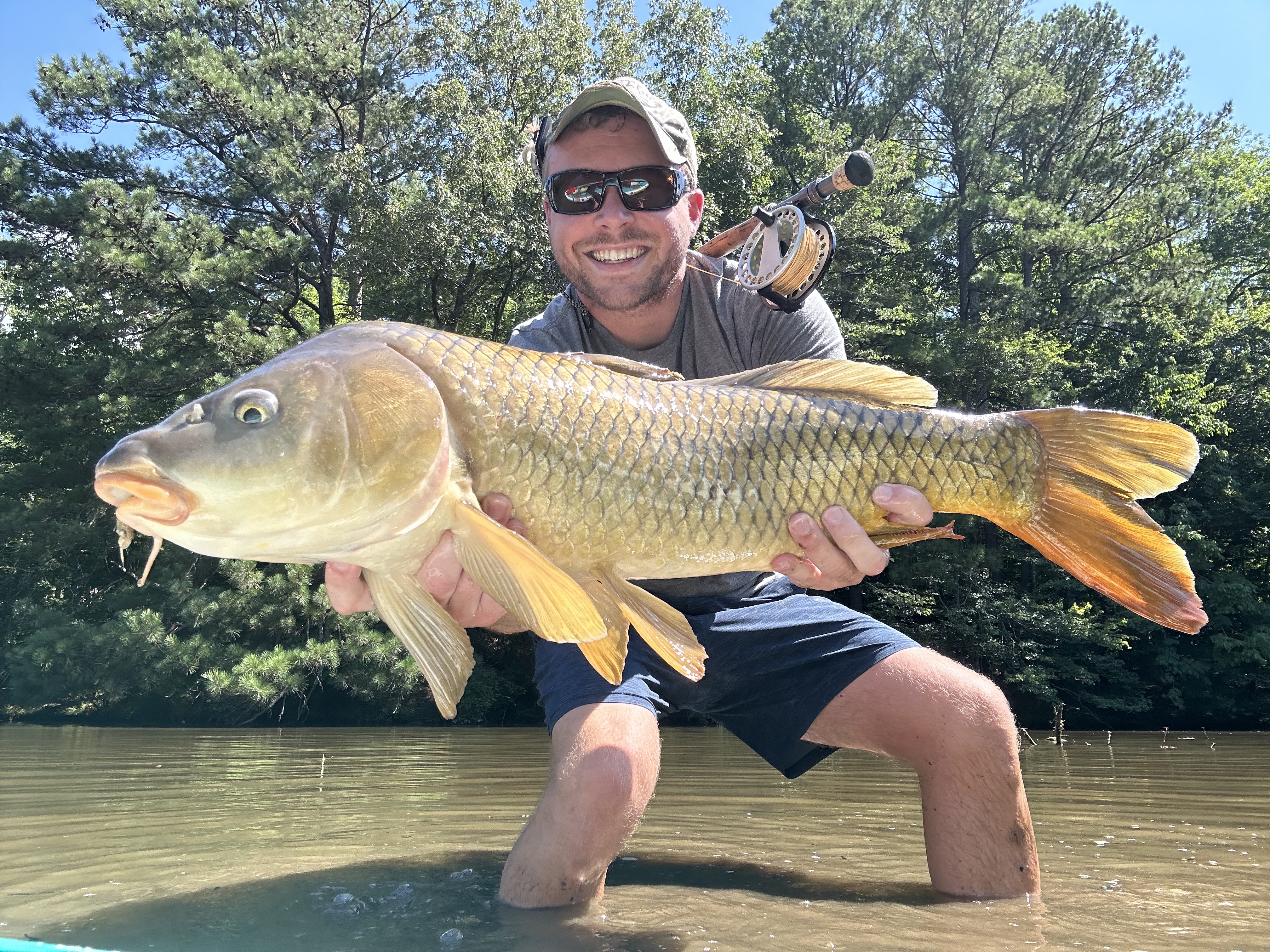
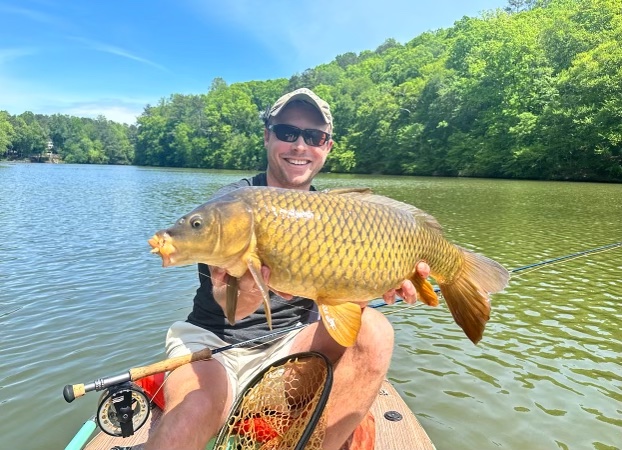
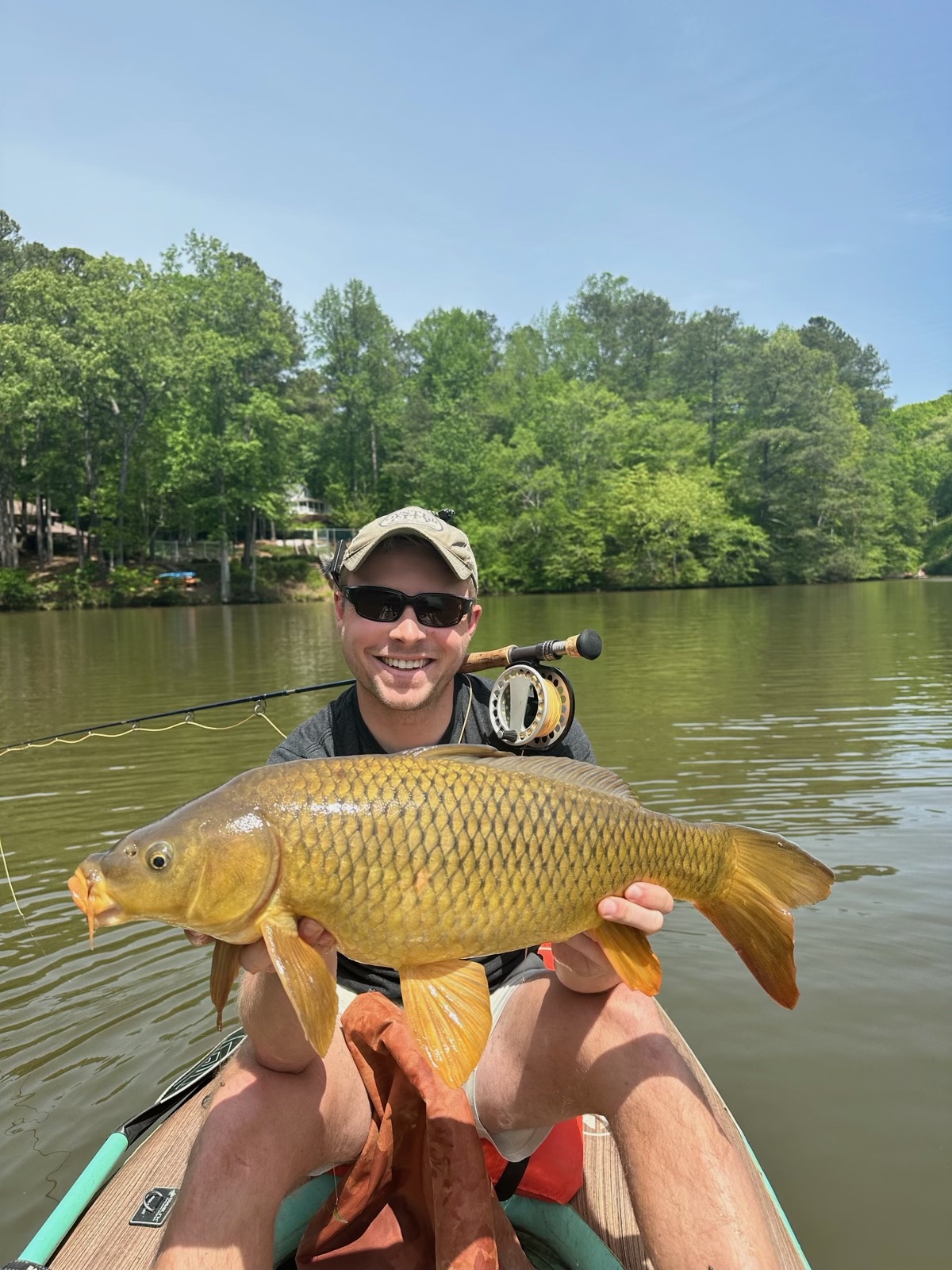
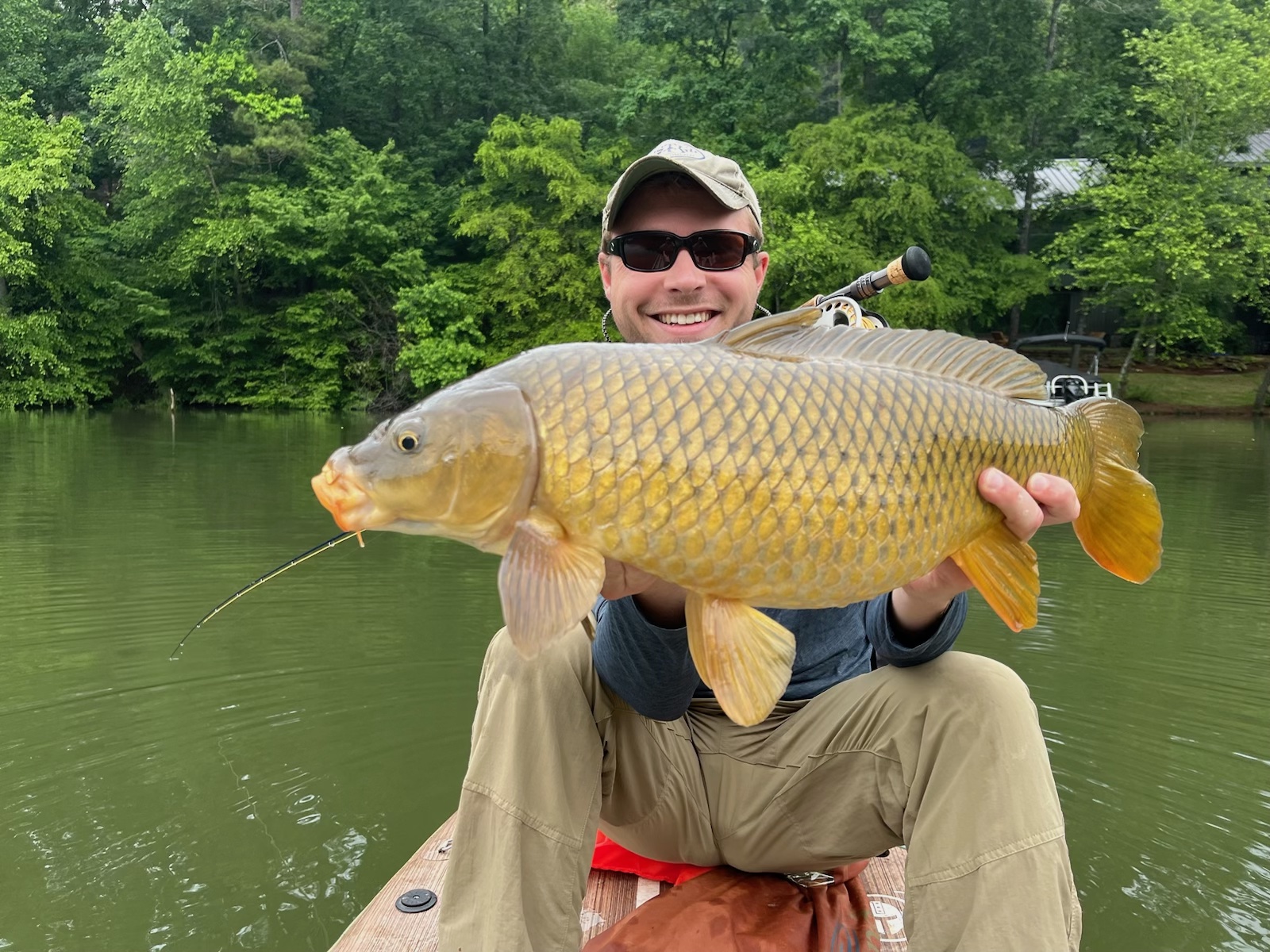
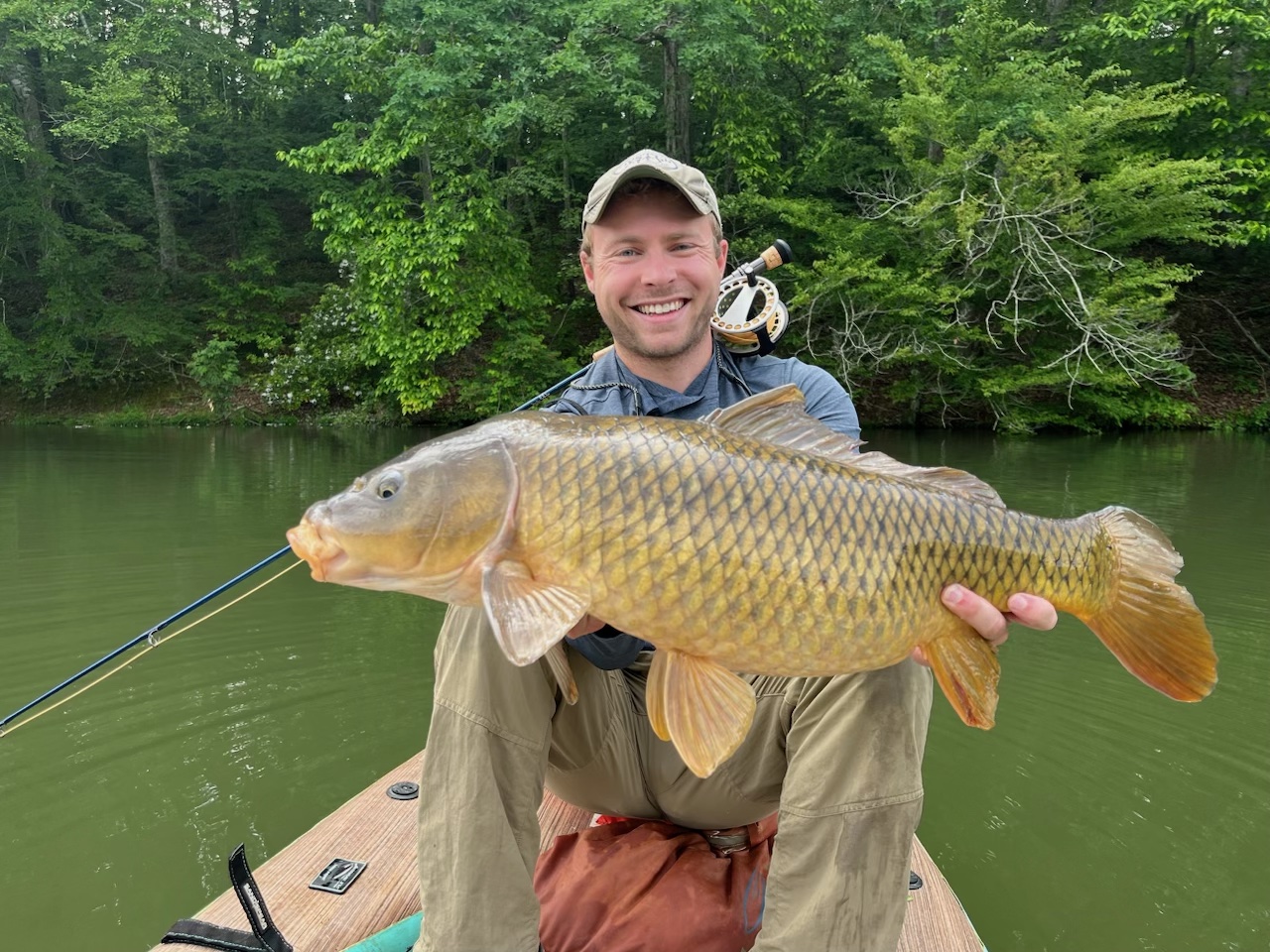
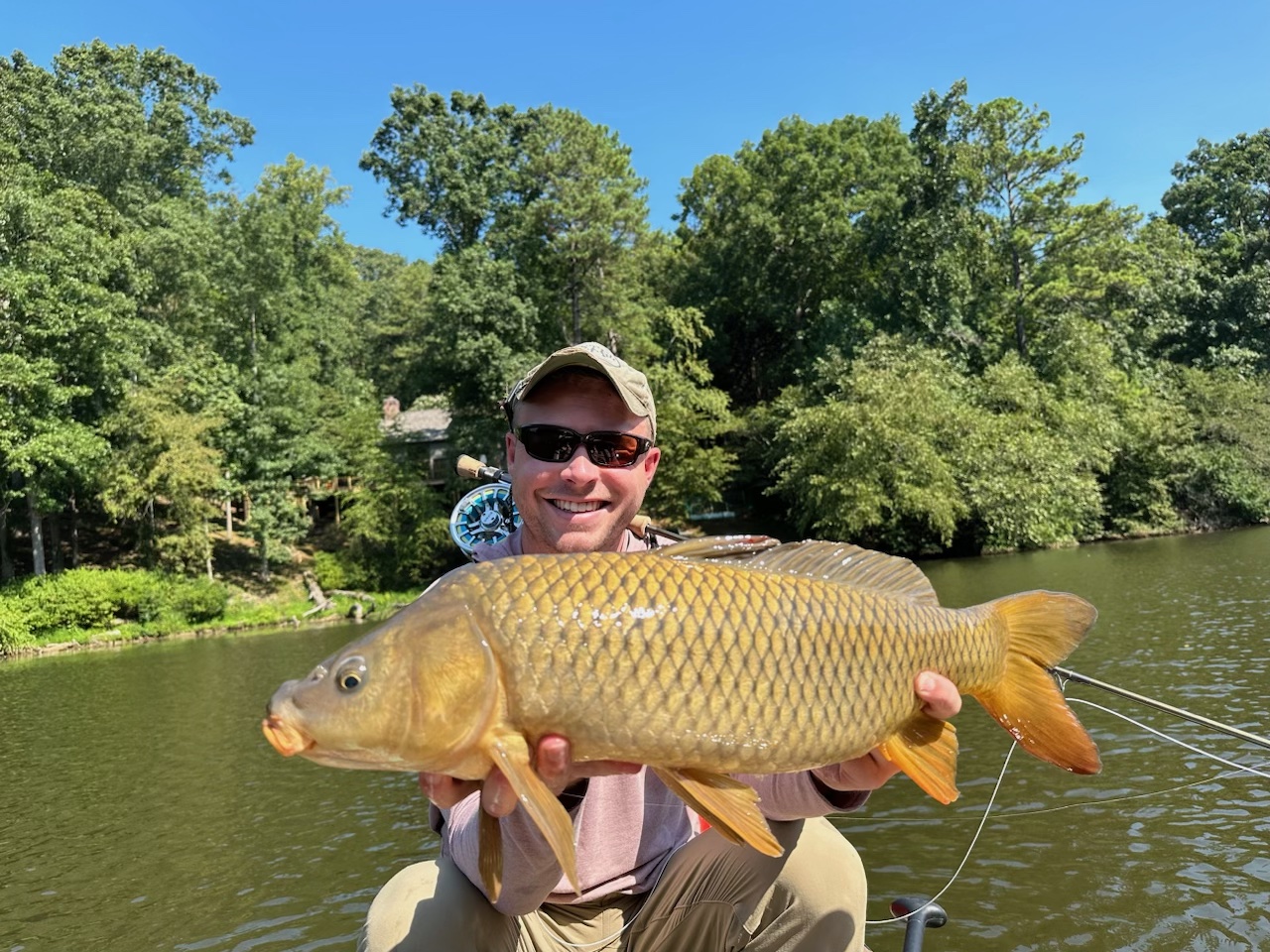
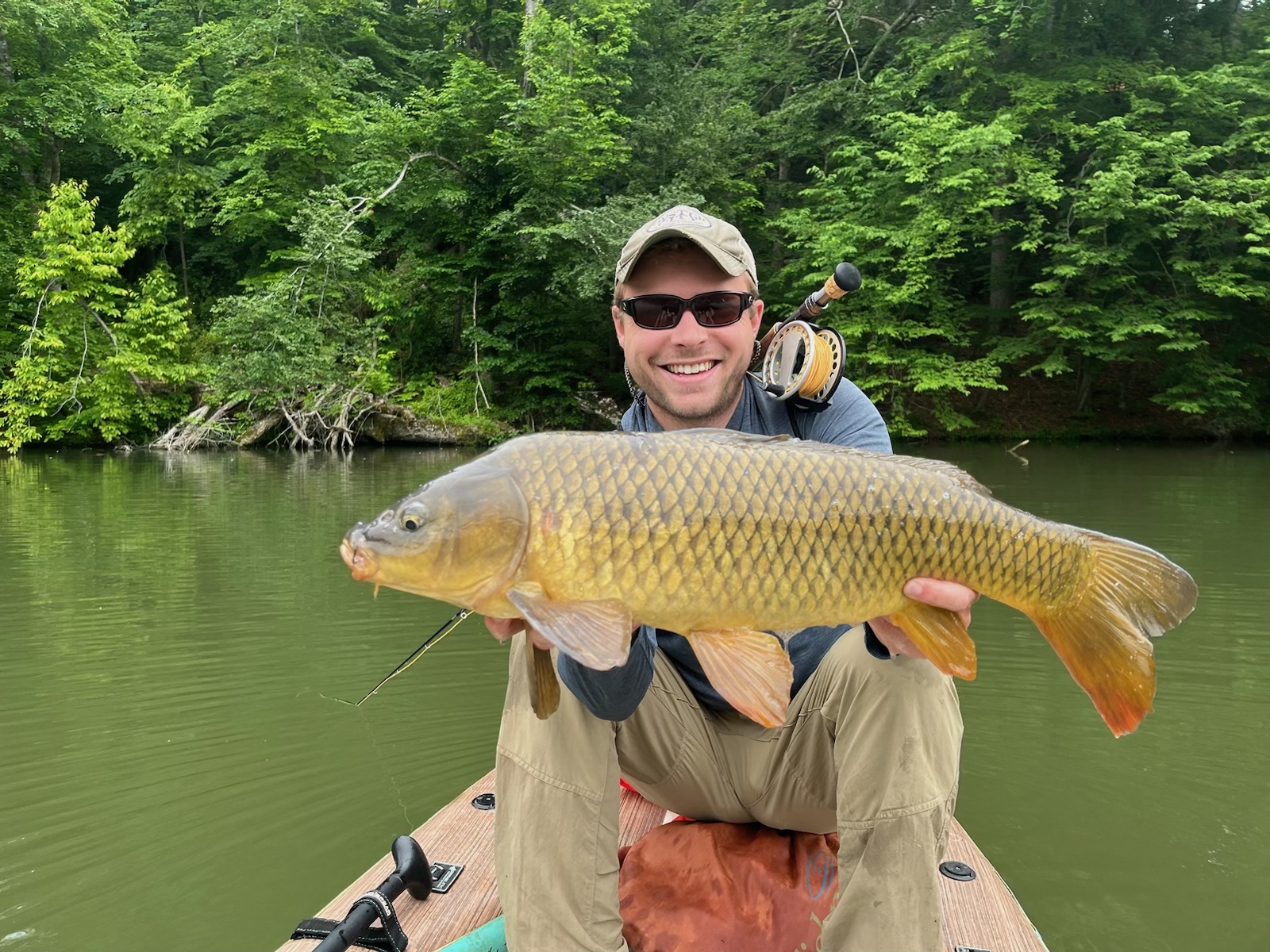
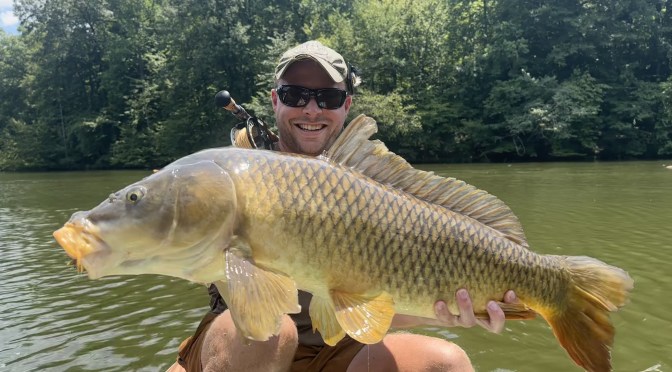
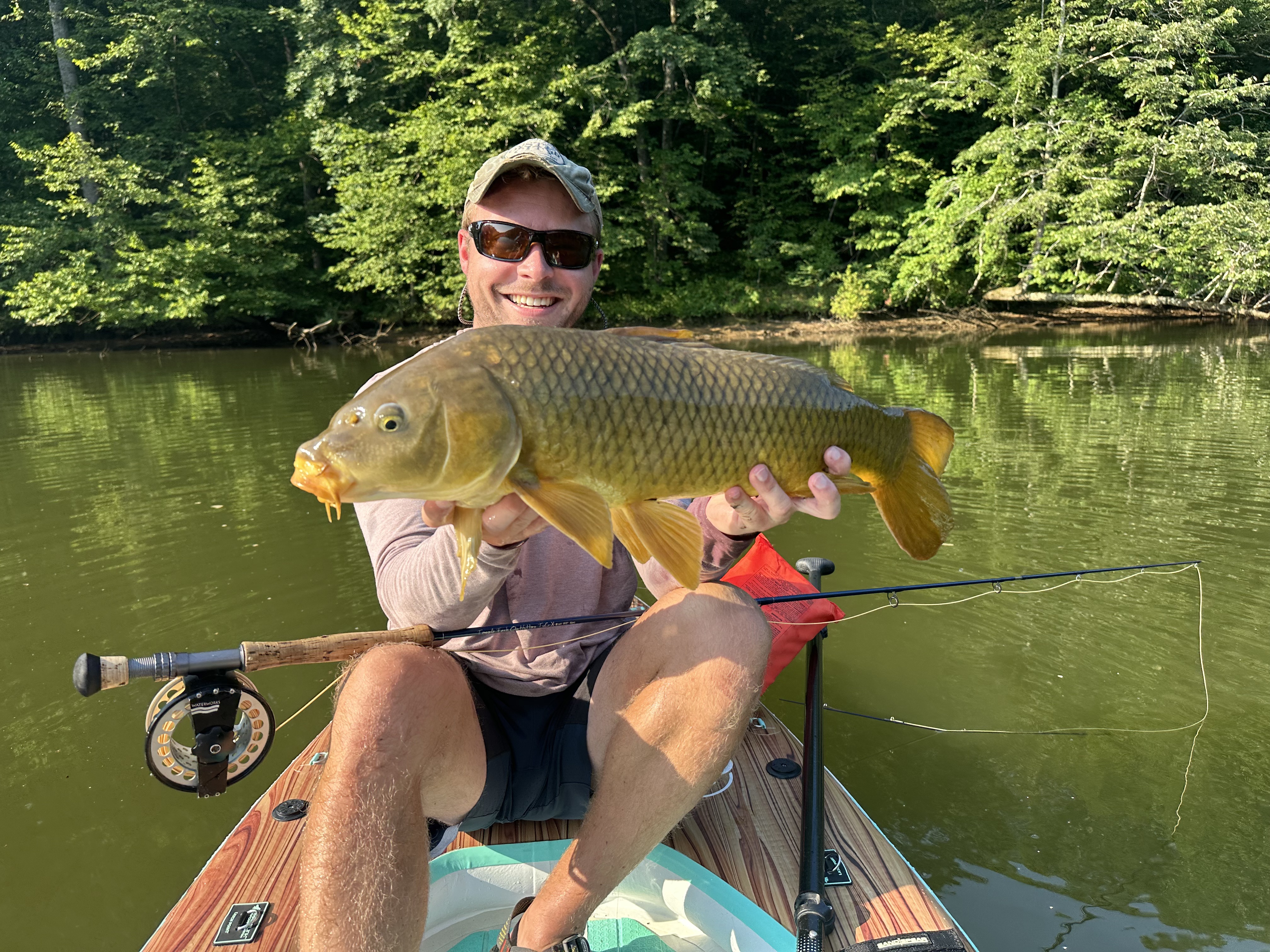
In 2024, the word I would use to describe the season would be “unreal”. I caught my largest common carp ever this year, and several amazing, very large fish were brought to hand. In between these fish were countless other terrific carp that kept drag screaming, smiles on faces, and paddle boards getting pulled around.

Joe Petrow – Carp

Due to the sheer amount of carp outings had throughout the year, I’m not going to do a “play by play” in this post, but instead go through some of my biggest lessons learned and highlight a few specific fish outings.

From a lessons learned perspective, these were the three common themes throughout the year:

  • When in doubt, have a “grub” fly ready. Although I have a handful of patterns that I’m confident a carp will eat, my hand-tied grub patterns this year produced the most amount of fish. They can be deadly with a “drag and drop”, and there were some difficult days in which this was the only fly the carp would be open to.
  • Don’t be stubborn on leader/tippet size. I traditionally am a fan of 15lb tapered to 12lb fluoro, but found that my landing rates on BIG fish increased this year on straight 15lb as I could horse some of the fish that were attempting to take the fight into structure. The heavier tippet may lead to less eats on tough days, but it’s worth it if you have a better chance to land large fish.
  • Don’t overlook an early evening paddle/outing. Although the majority of my carp days were mornings (lower wind, less people on the water), a few of my most productive sessions of the season were between the hours of 3pm-6pm. Lesson here is give it a go whenever you can.
Joe Petrow – Carp

From a highlighting of a few fish/outings perspective, these were the big three:

  • As mentioned earlier, I caught my largest common carp this year. This fish slowly slurped a grub fly and proceeded to put up the craziest fight I’ve had on the paddle board. This fish was absolutely 25+ pounds.
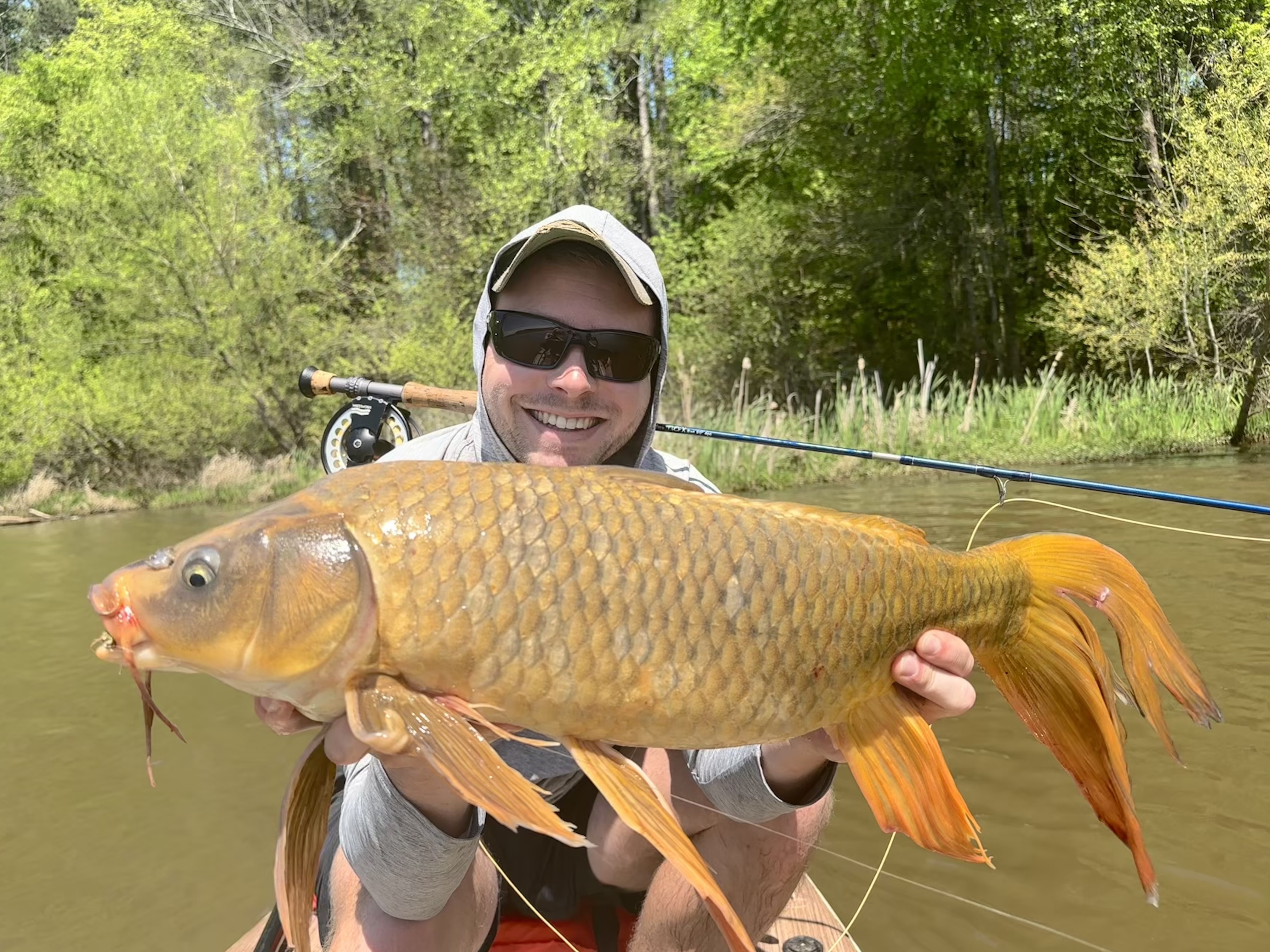
  • I caught my first, large Koi/Carp hybrid this year. The spawn was an extra sight to behold this year (hundreds of carp going crazy), and for about a month you could catch the non-spawning fish in thee midst of the spawning fish. Wild to watch.
  • Earlier this year, my larger Bote board when out of commission (we had a great run). In the interim of purchasing a new one, I did a few carp outings on my much smaller paddle board. I landed a huge common carp on this board that dragged me all over the place for 10+minutes, and I had to get out to land it without falling in. Good news was that it took me close to a shallow flat!
Joe Petrow – Koi/Carp
Joe Petrow – Carp

Cannot wait for Carp Season 2025 and always grateful for these fish! Long live the carp.

Tight lines!

Joe Petrow
Long Weekend Stripers

As most serious fly fisherman can relate to, the fish you frequently target can often evolve throughout the course of your life. Some fish you grow up with, and some fish join the journey later in life – both have a special place in your heart. For me, Striped Bass (specifically in Maine) were one of those fish that I really started to become ecstatic about later in my twenties. Over the past couple of years, I’ve continued to dedicate the time (on both the water and fly tying vice) to learn more about how to catch Stripers, and our annual trip to Maine in 2024 led to some of the best encounters I’ve had with these fish.

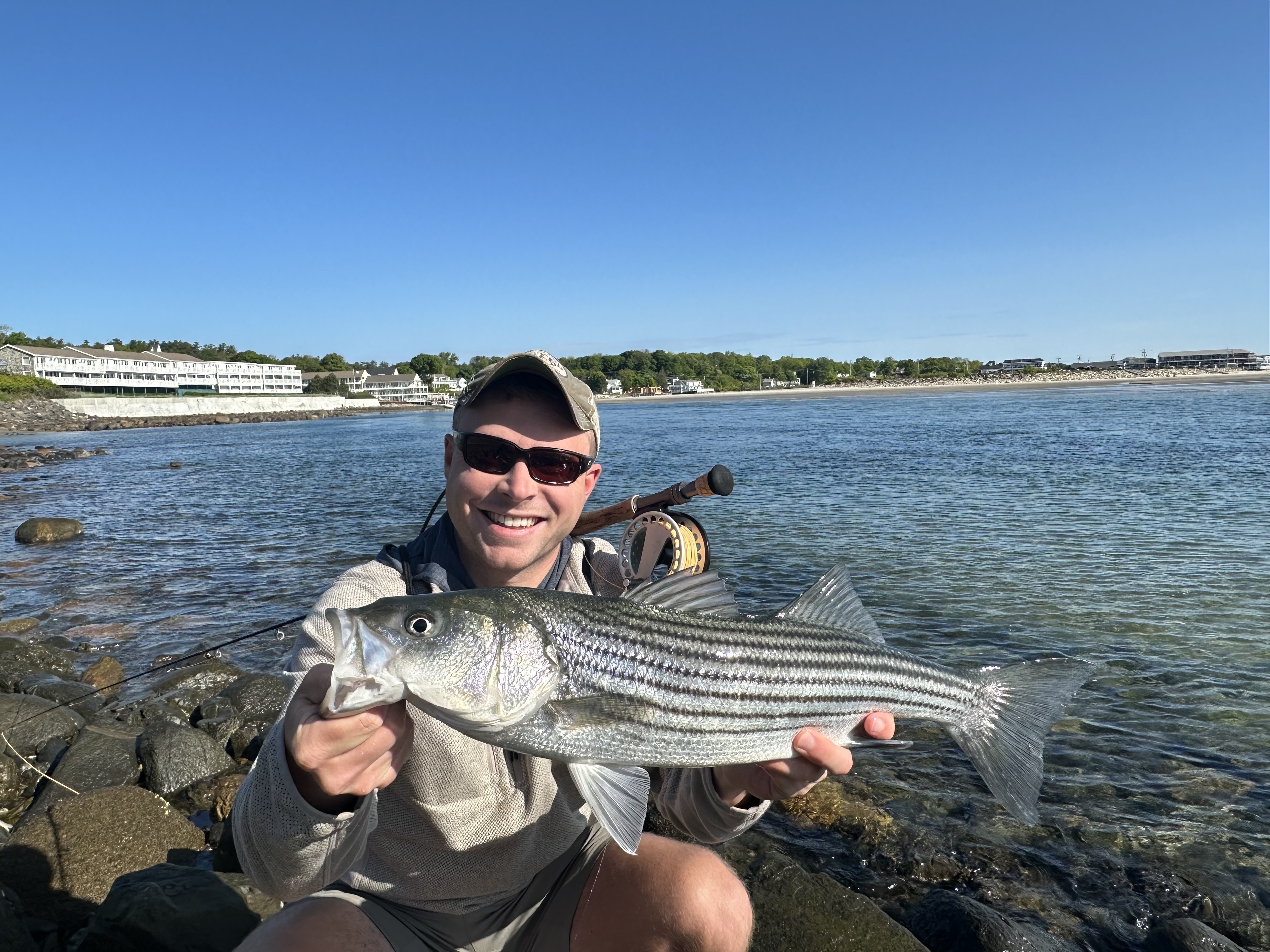
Similar to pervious years, we ventured to Maine in late May, and were met with the best possible weather conditions (not an exaggeration). Super sunny skies, warmer temps for the early summer, and low winds. Although Stripers typically prefer some clouds/wind/elements to really turn on the feed bag, the sunny conditions on this trip really allowed some terrific opportunities to sight fish. To mix it up from previous years, I wanted to do two things this trip when it came to fishing: throw bigger flies and find new water. Although I had a few terrific spots that produced fish on my usual clouser/smaller baitfish patterns, I really wanted to throw some larger bucktail patterns and explore my “spot” horizons. With that said, I was optimistic that this could be a fishy weekend, as I was able to catch a nice striper on a larger bucktail fly (in one of my usual areas) on the very first evening in Maine. This fish was sitting in a HEAVY outgoing tide and hammered the fly only about 5 feet from the trip of the rod, and put up quite the fight. After a few quick shots, the fish swam off strongly and I went to go celebrate with a blueberry beer.

Joe Petrow – Striped Bass

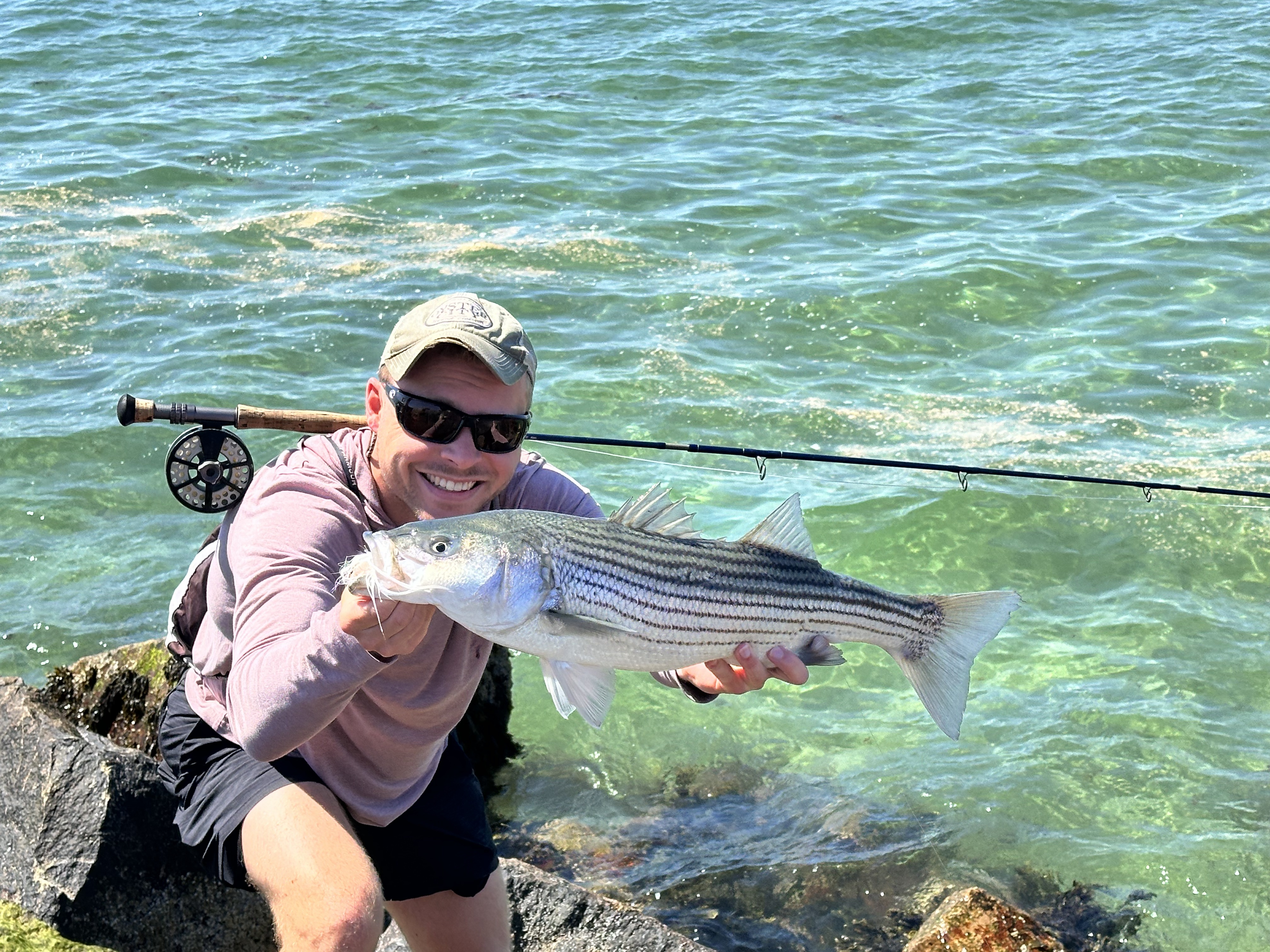
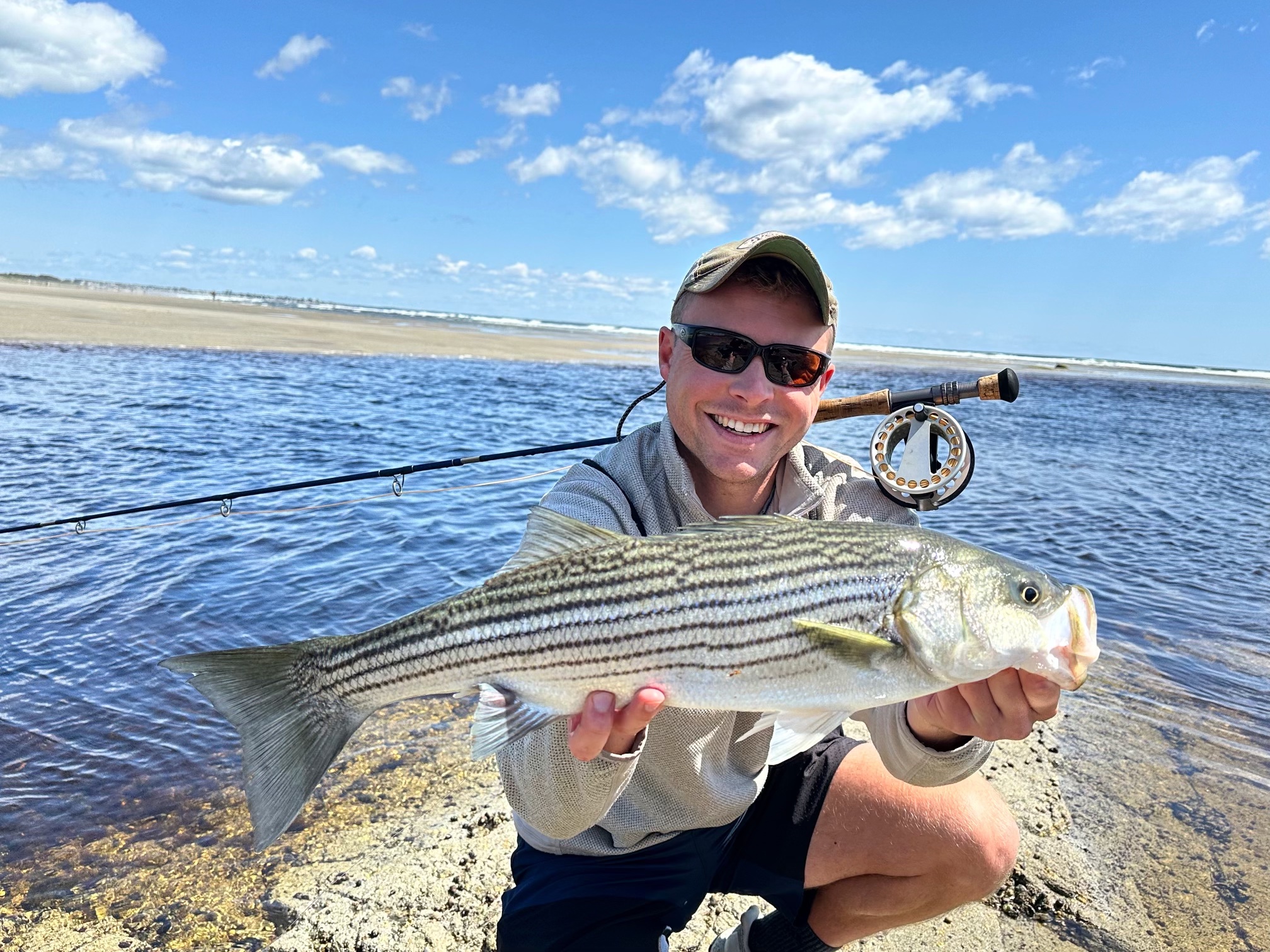
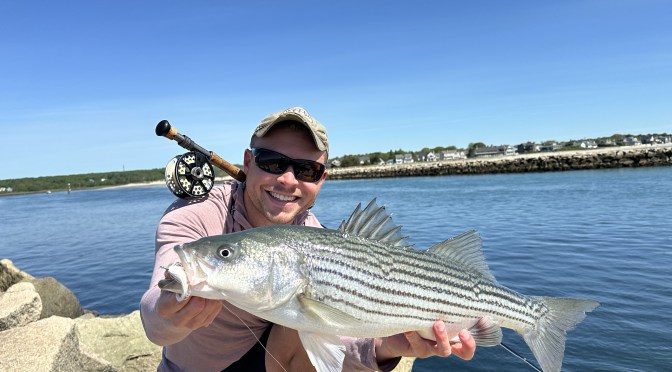
The next day ended up being a day that really one that dreams are made of when it comes to throwing some fly line. My girlfriend and I slept in a bit, picked up some donuts, and arrived to a new fishing area that I wanted to check out by about 10am. I had my same larger bucktail fly on from the evening before, along with an intermediate sinking line to help get the fly down if current was present. Within about 30-minutes of walking the beach and jetty looking for fish, I couldn’t believe my eyes…there was a school of about 25-35 striped bass circling the beach about 80 feet off the shore. I sat and watched these fish slowly get closer to the rocks/shore, and tried to keep my heartbeat down and fly line ready. The school of fish settled in about 60 feet out and I let out a long cast…let the big fly slowly sink…did some quick sporadic strips…and the fish were on it! Four to five fish started chasing but not committing, until finally a BIG striper came up and engulfed it. Striper on! The fight that ensued became utter chaos from the rocks, and I was able to fortunately land this fish for an awesome picture. This was my largest striper to date, and I was extremely grateful for the moment.

Joe Petrow – Striper

For the next hour, the school continued to patrol the area, and I was able to land 3 more fish (had another get off by the rocks). All of the fish were extremely nice, but not as big as the first one). Similar to the first fish, these stripers were all over the larger fly – just had to adjust the strip based on the body language of the fish. I threw to one specific fish multiple times, until finally I ripped the fly as fast as I could and then it finally hammered it. You could tell that the sunny conditions definitely had these fish a little skeptical to eat, but the sheer number of fish in the school kept them aggressive enough (and competitive to beat each other to the fly) where it didn’t prevent fish from being caught.

Joe Petrow – Striper

As for the final day of the weekend, we returned to the same area, and was able to land one smaller Striper and hook another. The large school was no longer there, but I noticed some fish sitting in the fast current a little bit closer towards a river mouth. Had a few very nice fish (including one possibly bigger than the first day) chase the bigger flies in, but not commit. I ultimately down sized the fly to focus on the smaller fish I was seeing, and this proved to work.

Joe Petrow – Striper

As always, can’t wait for the next trip up to Maine and continuing to put the time in to go after these awesome fish.

Tight lines!

Joe Petrow

Tarpon, Triggers, and Right Place at the Right Time

This year, I was fortunate enough to have a rewards trip for work get scheduled in the Bahamas. Although I would’ve loved nothing more than to spend this entire week with my girlfriend searching for bonefish on one of the lesser populated islands of the Bahamas, this trip required some work, making me get creative when it came to finding some productive time to throw a fly rod. One thing that really held true to me in 2024 was “when in doubt, bring a fly rod if you’re going to the beach”, and this trip was no exception.

Although the water in the Bahamas was beautiful upon arrival, the area we were in was in no way secluded. Several resorts around, lots of boats in the water…that kind of deal. With that said, I had some hopes that if I just started putting in some miles on the sand that MAYBE I would be able to see something swimming around. Fortunately for me, I lucked out, found some fish, and made the most out of these rare opportunities.

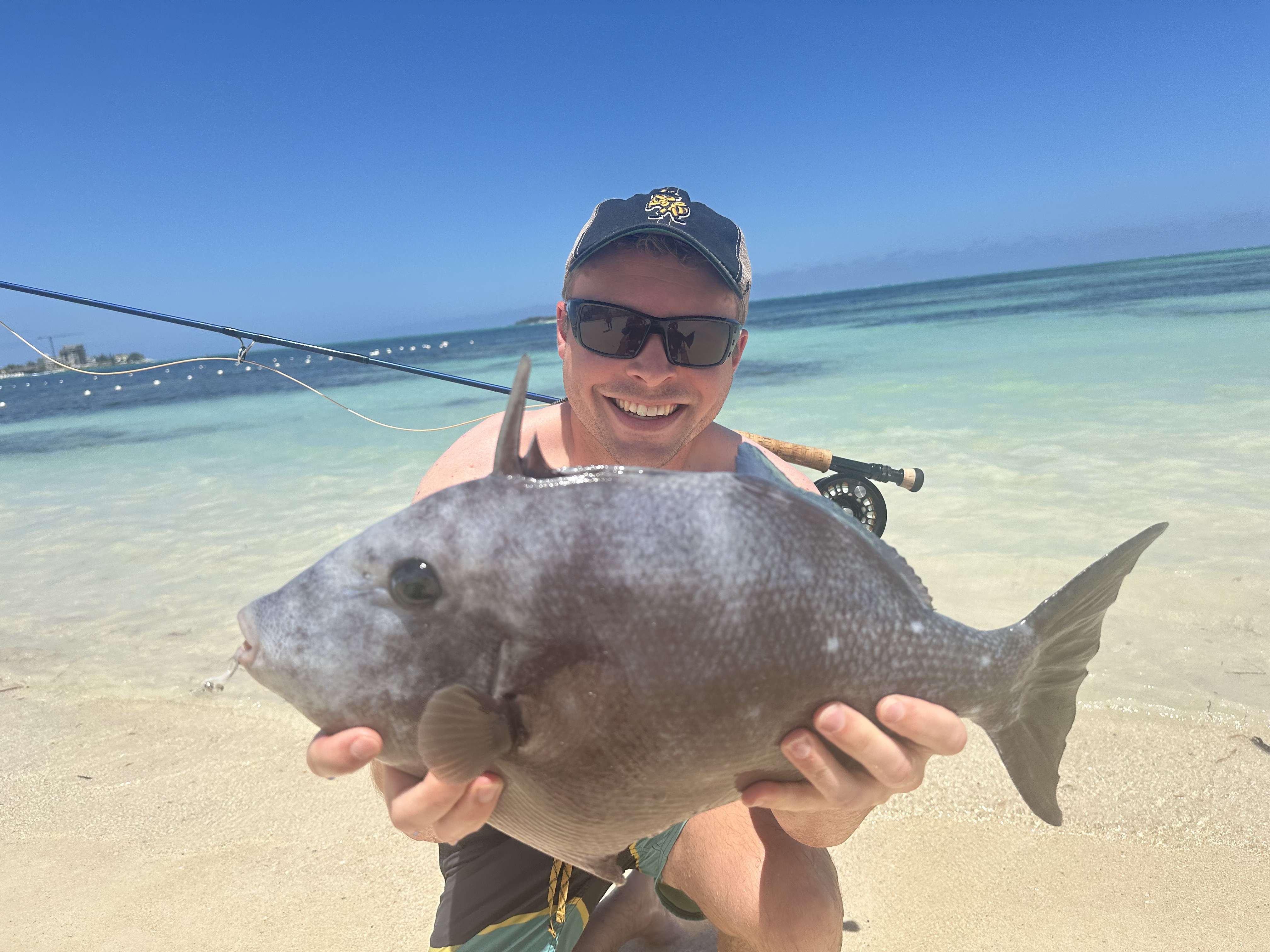
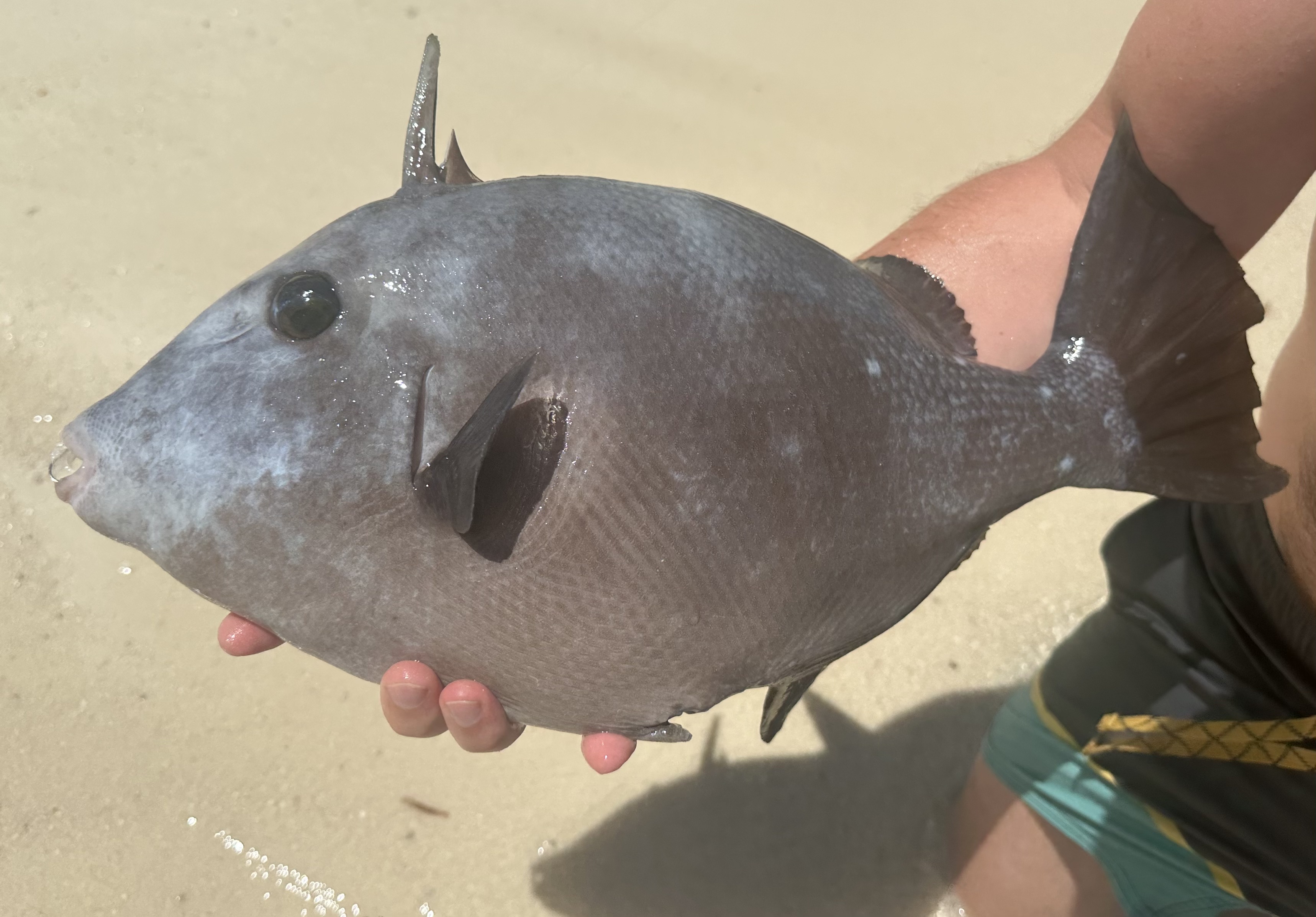
During our first afternoon “off”, my girlfriend and I walked to a considerably less busy flat about a mile away from the hotel. Upon arriving to the flat, life was obvious. Stingrays swimming around, schools of extremely small baitfish getting bothered by baby barracudas…all extremely positive signs. I had a small shrimp pattern tied on (very optimistically thinking that maybe a bonefish would be around), and this would turn out to be a good call but for a different reason. After catching a few very small snappers throwing into a single deep hole off the flat, I noticed a big, dark tail appear on the flat itself. After staring at the tail for a good 20 seconds wondering what it was, I finally realized that it was a large Ocean Triggerfish and got to casting. Follow after follow…I got this fish excited on the fly. It would swipe at it, miss, swipe again, eat it but not get the hook in the face…until finally my line went fully tight after a surge towards the fly from the fish. Trigger on and the fight was unreal! This fish took me deep into backing on the first run, and easily took 10-minutes to get in. This was my first Ocean Triggerfish and I was ecstatic to get this guy off the beach.

Joe Petrow – Triggerfish

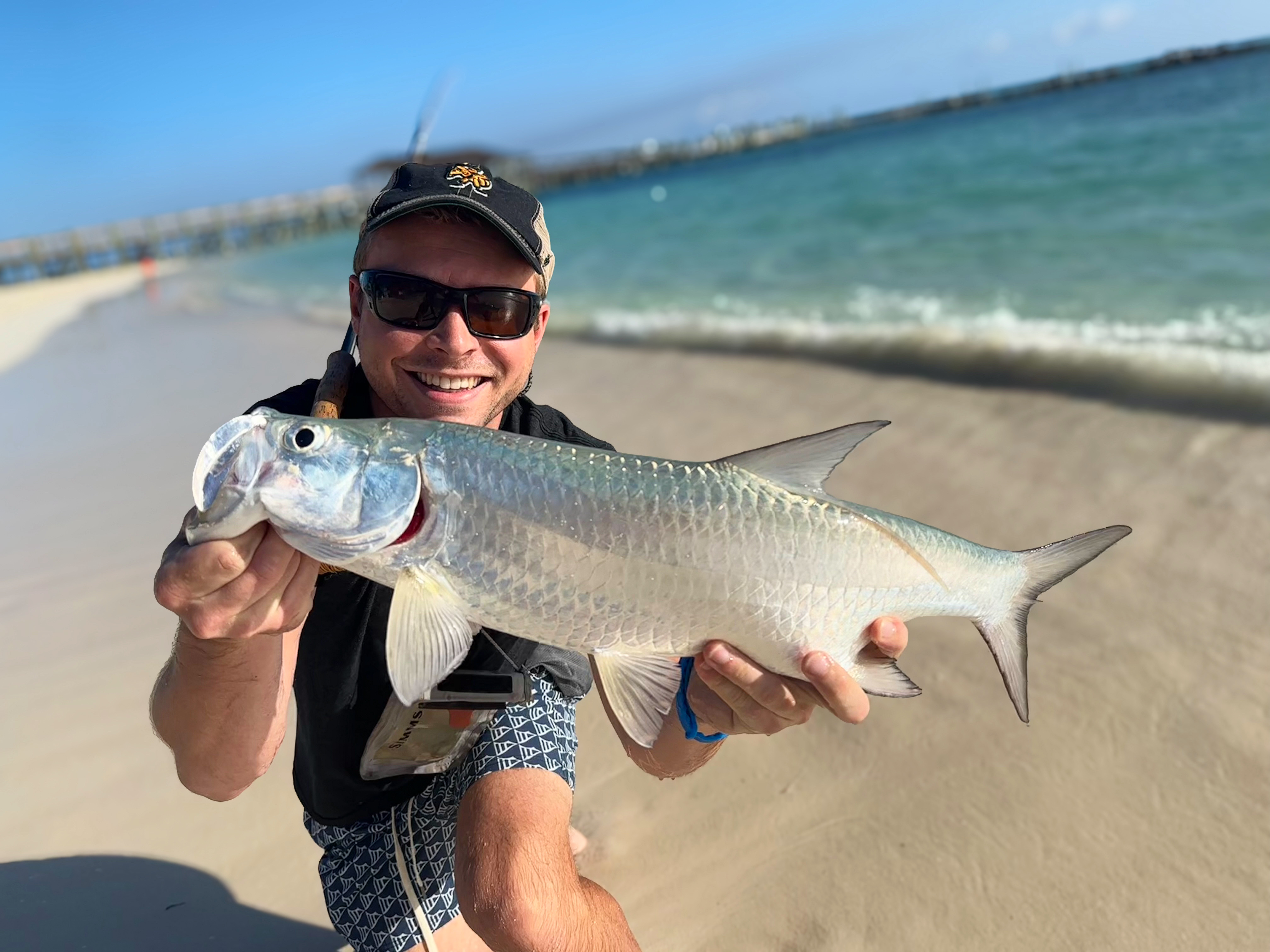
Later in the week, I took an early morning walk on the beach the following day, I noticed a pod of four to six juvenile tarpon patrolling around (!!!). These fish were swimming parallel on a specific stretch of the beach that seemed to have a slightly deeper trough about 30-feet off the beach. Having been on the search for more triggerfish again, I had a small shrimp fly tied on, and made the decision to switch flies as quick (and calmly) as I could. I had a few of my go to black craft fur and bucktail flies in my box, and got one rigged relatively quick (considering how much blood I had pumping). Fortunately for me, the fish had maybe only moved down 200 feet on the beach and I was able to track them down, get a leading cast out, and boom…tarpon on. After several jumps, unlimited head shakes, and a few too close to call moments right by the waves breaking, I was able to land this fish. What an awesome moment from foot right off the beach.

Joe Petrow – Tarpon

The moral of the story from these fish is when in doubt, bring a rod with you to the beach. Even though there will be many times where nothing is seen, the times where fish decide to show up makes it all worth it.

Tight lines!

Joe

Canal Hopping for Peacocks

South Florida…in my opinion, one of the best locations in the entire United States to throw a fly line (especially if you are like me where the more species encountered, the better). Although many people associate South Florida fly fishing with hitting the saltwater towards the Keys, my mind immediately thinks about the canals in Miami/Fort Lauderdale where you can find species that are no where else in the country. In addition to this, when the rest of the country is dealing with colder weather and fishing seasons winding down, South Florida remains warm enough where you can escape to a convenient “paradise” for a few days and get on some fish.

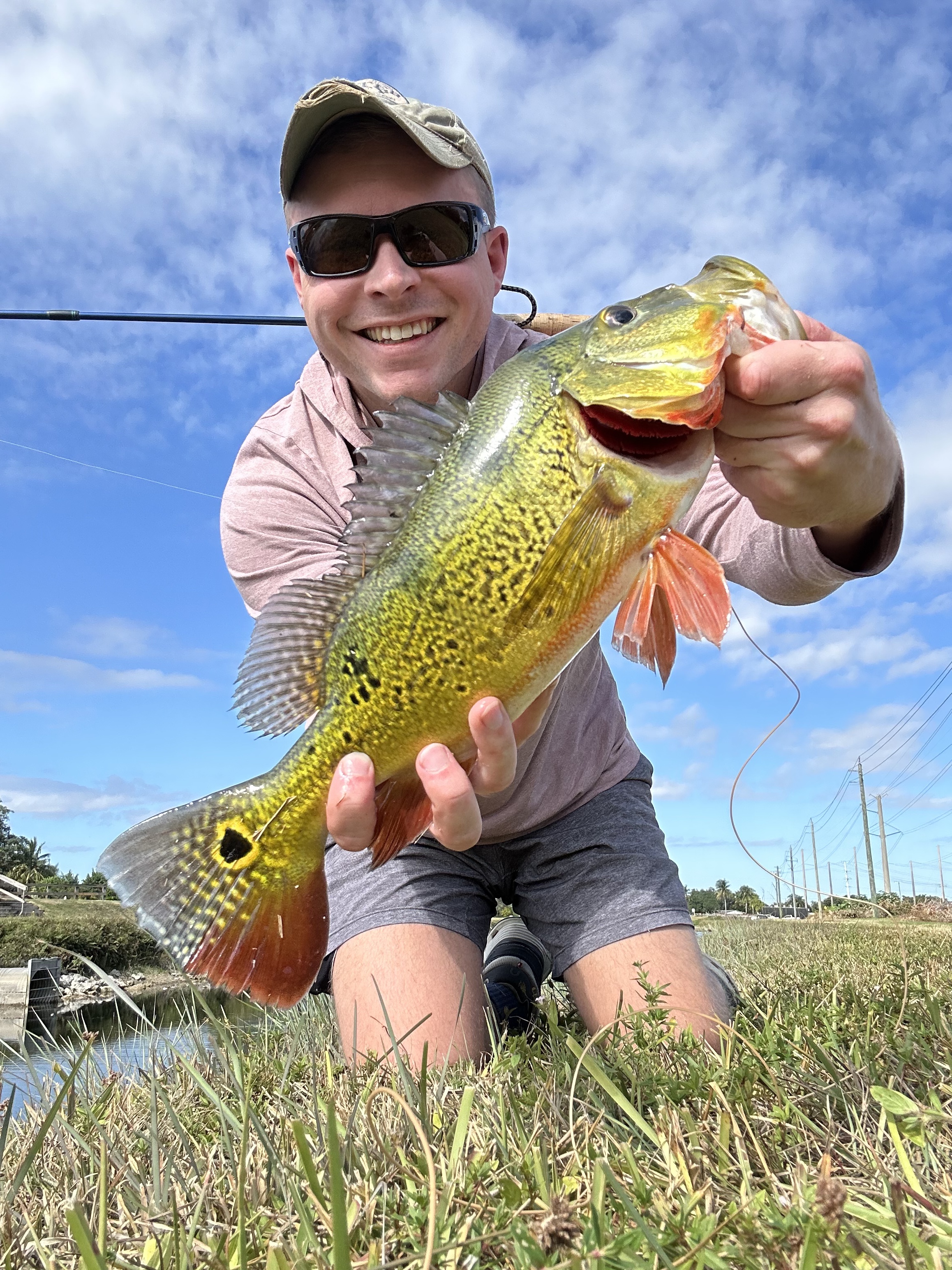
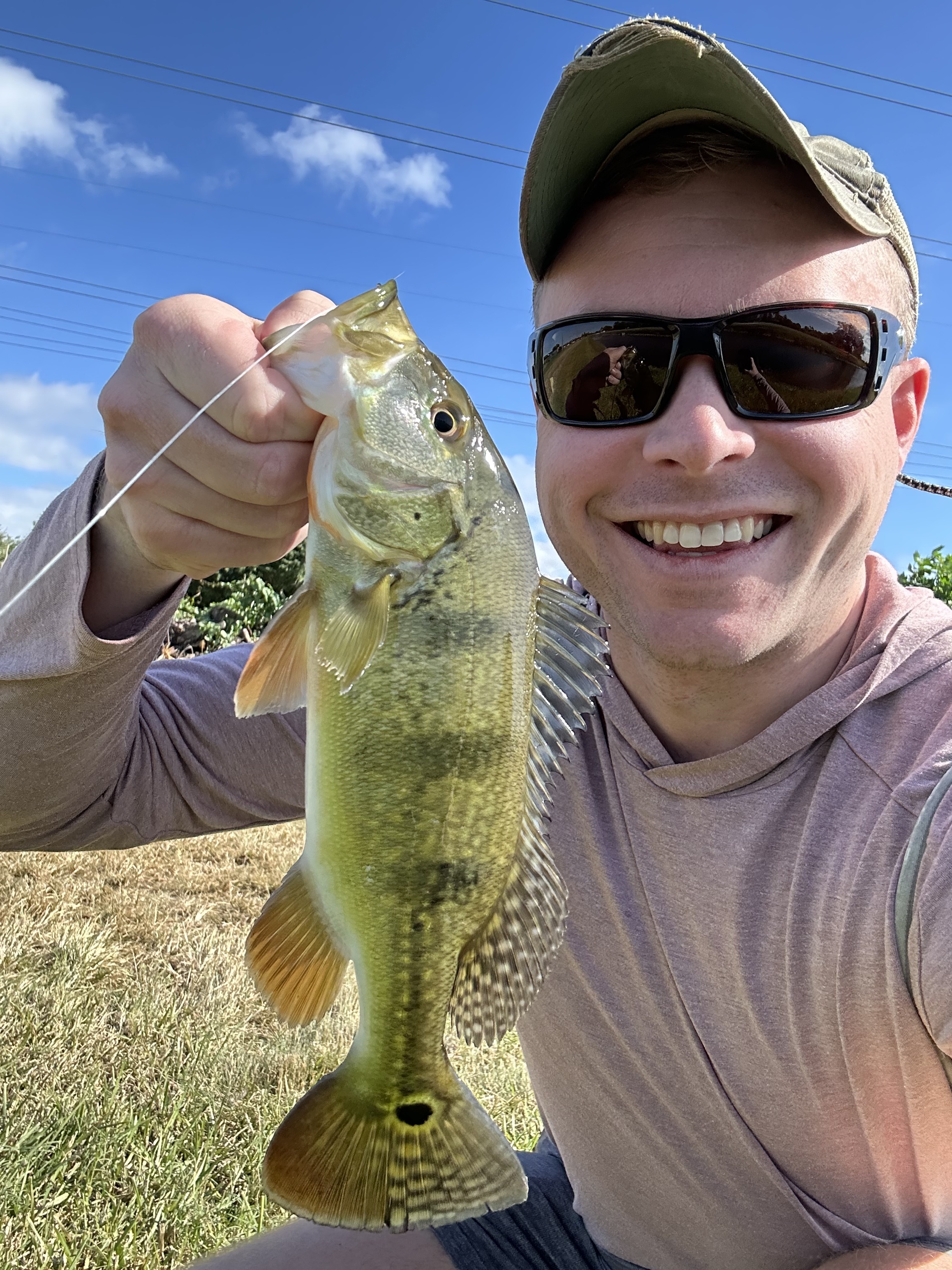
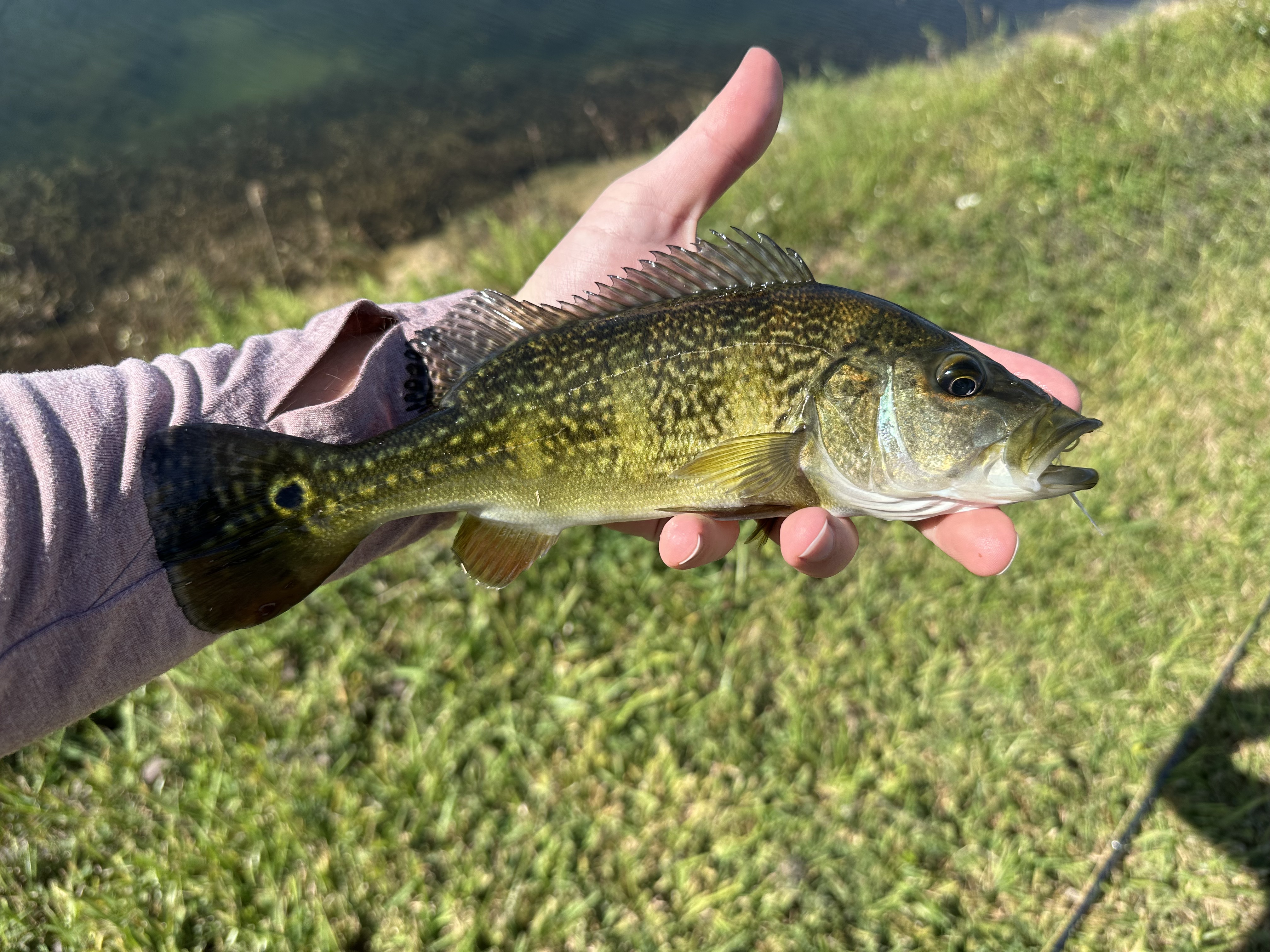
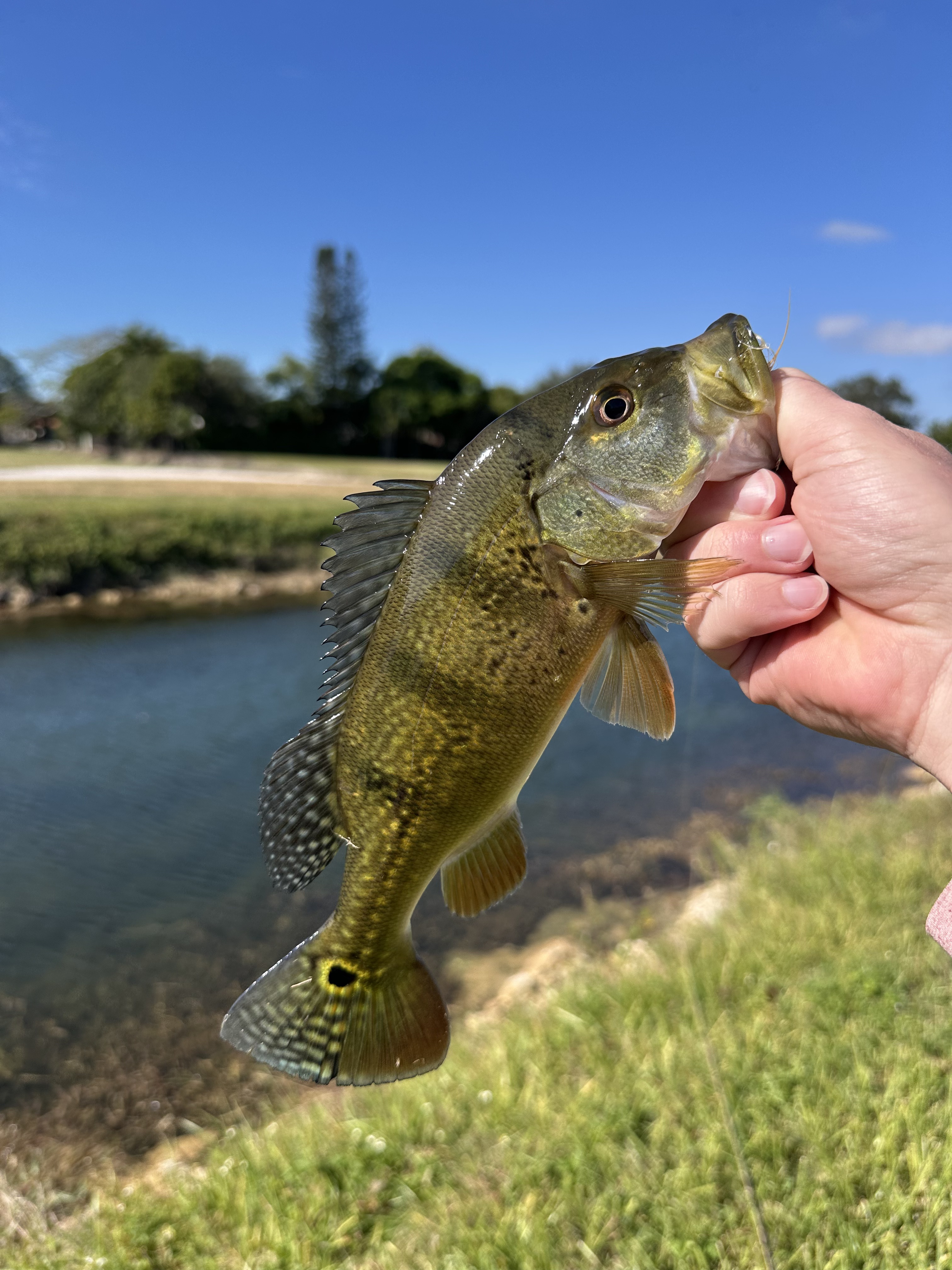
I was fortunate enough this year to visit the Miami area twice (once in January and then once in November), and during theses visits, I was able to find and catch a fan favorite… the Peacock bass. I found most of these fish in two specific canal systems in shallow water.

To kick it off, the conditions presented a major challenge. Peacock bass (with origins from the hot, humid climate of South America) THRIVE off of warm weather and warm water, and you will have an exceedingly difficult time finding them during big cold fronts. I ran into cold fronts in both January and November, but fortunately was able to figure a few things out and find some areas that held fish. Although the fishing was tougher, I found that doing the following produced the most fish for me: sleep in and only fish during the warmest part of the day, and strip the fly as fast as you possibly can. For full transparency (as I like to do on this site), I woke up super early two mornings thinking that this might have active fish, only to find out (and even see) that these fish weren’t ready and warm enough to eat.

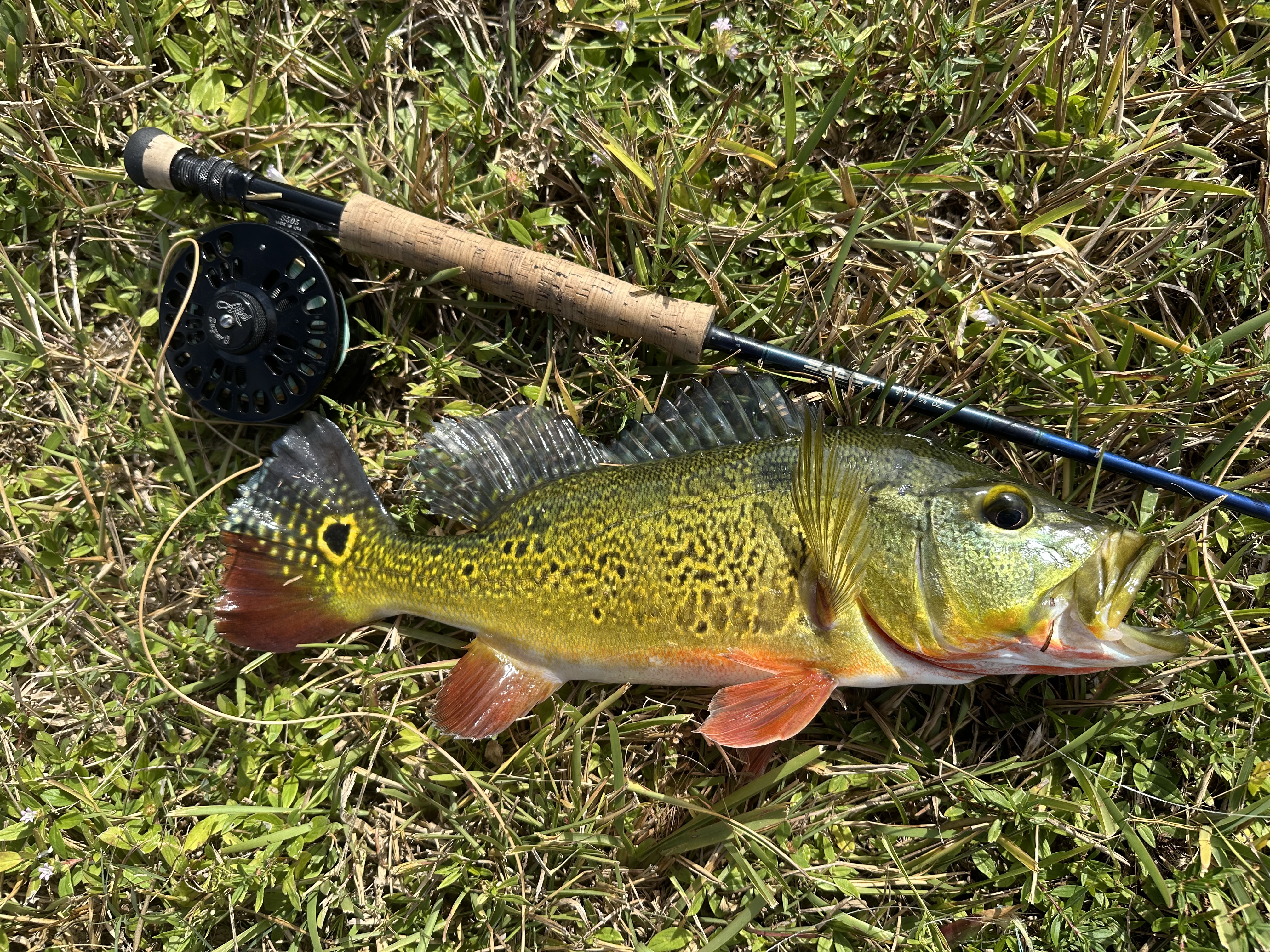
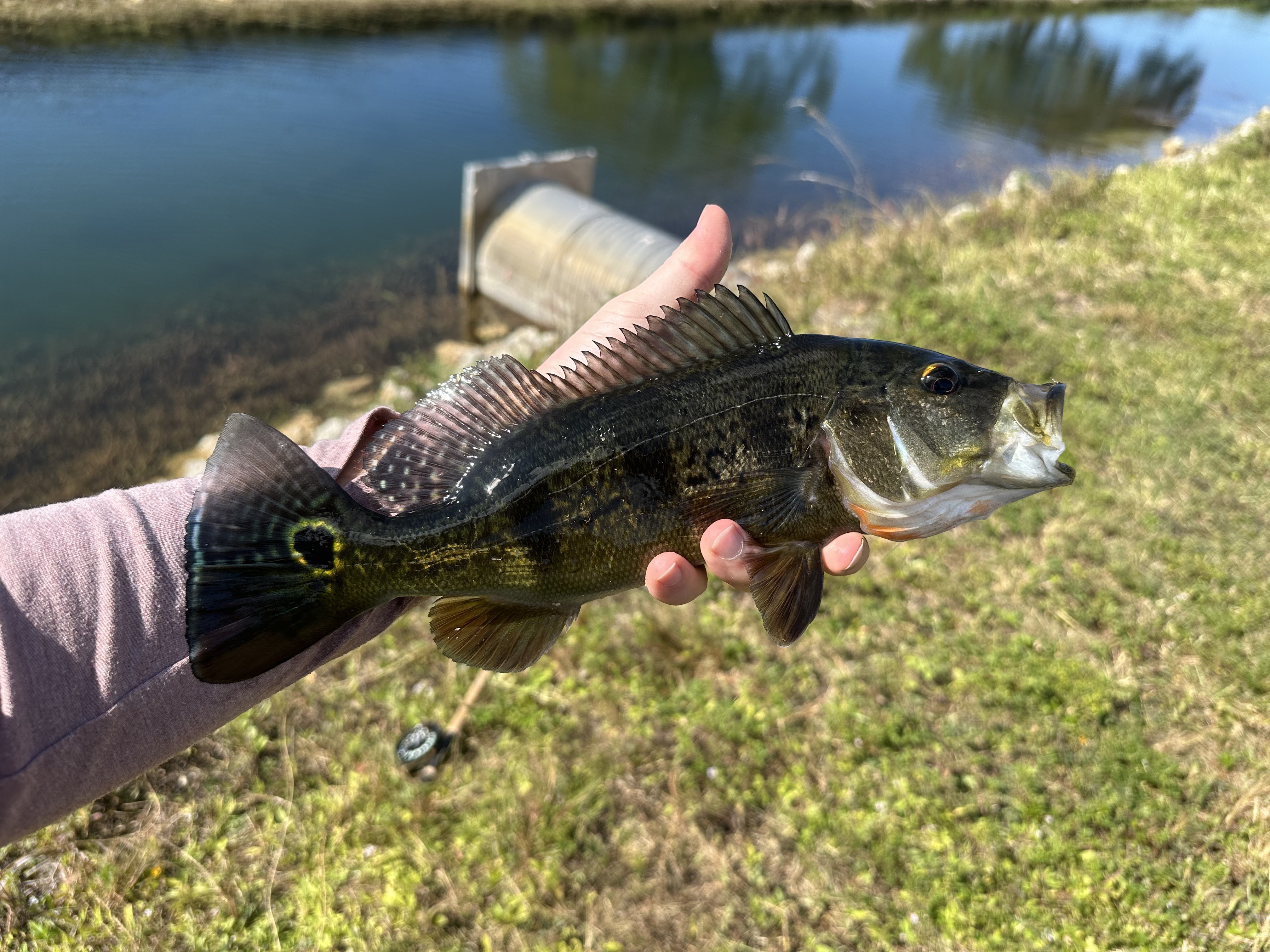
Once it was warm enough, flies were eaten, fights were had, and beautiful fish were brought to hand. The best thing about fly fishing for peacocks is how visual it can be – these fish are often times hugging the shore shallow, allowing you to sight fish to your hearts desire. If you fish for them during the spring and summer (which I’d honestly recommend over the colder months), you can even find these fish on aggressive and shallow on beds. For my outings this year, I found my best peacocks under vegetation waiting in ambush to smack prey. Throwing any small white or chartreuse deer hair fly, and stripping as fast as I could, did the trick! I sight fished the below peacock (one of my largest ever) in this exact fashion, and it put up a terrific fight on the 8-weight.

Joe Petrow – Peacock Bass

Although I had a handful of successful outings, I very much look forward to returning to the canal systems during warmer months of the year to see if larger numbers of “bigger” fish can be found. I’m a big fan of any sized peacock as they are one of the most beautiful and best fighting fish you can find (great examples of what I’m talking about below) I’d love to sharpen my skillset on consistently finding larger fish. I also need to commit some time to searching for Snakeheads and Clown Knifefish on the fly!

Joe Petrow – Peacock Bass

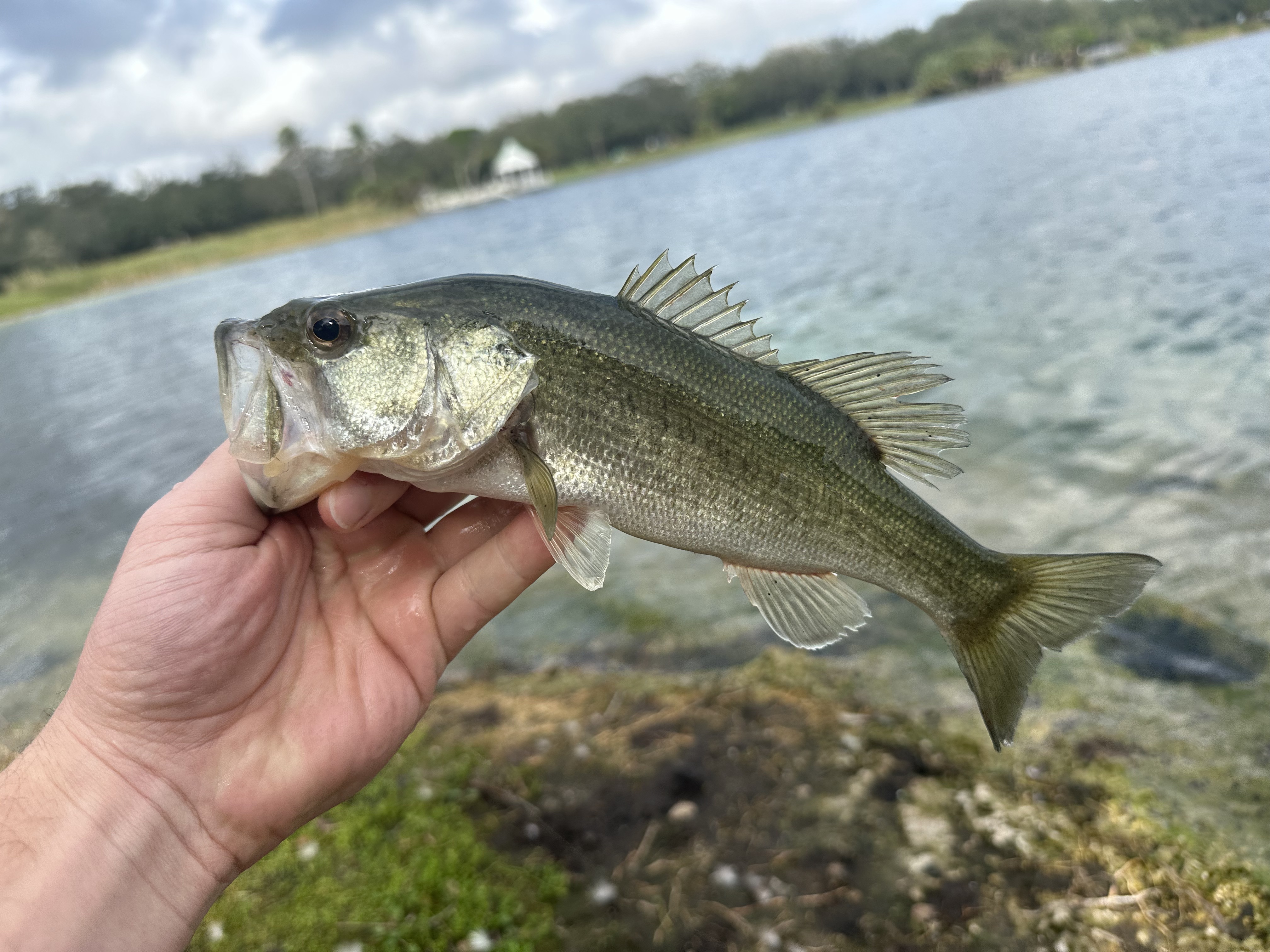
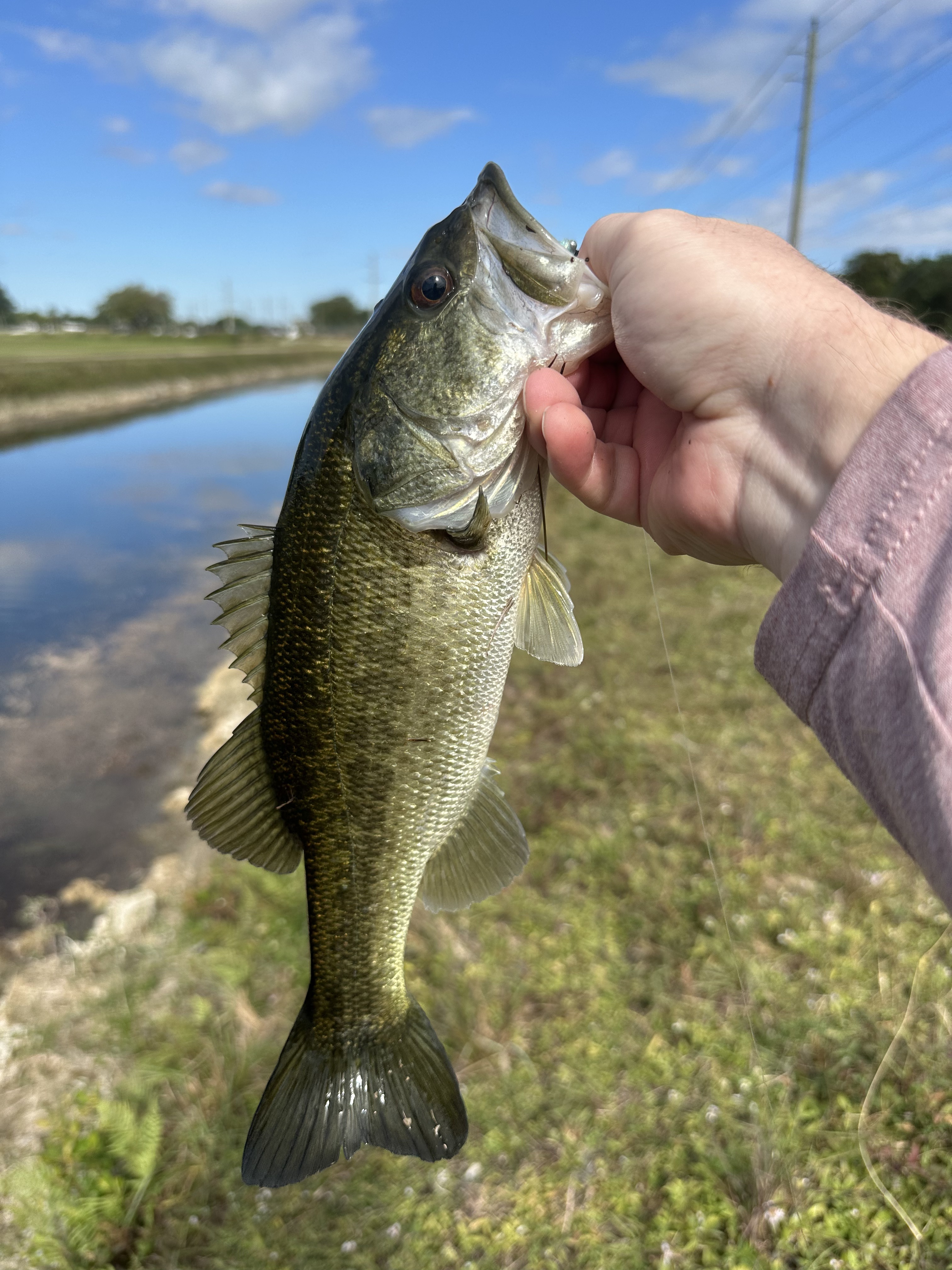
In addition to this, I do want to highlight that the largemouth bass fishing seems to improve with some colder weather. While searching pretty exclusively for peacocks, I caught countless largemouth along the way. Need to appreciate this local species as they helped keep the rod bent during the colder days!

Tight lines!

Joe

Florida Outback

To start…what a year 2024 was on the water. In my typical (unacceptable) fashion, I find myself playing catchup on my fly fishing adventures from the year rather. I am committed in 2025 to make a much more diligent effort to do posts in real times after my outings, as it’s always fun to recap and keeps the blog updated in real time.

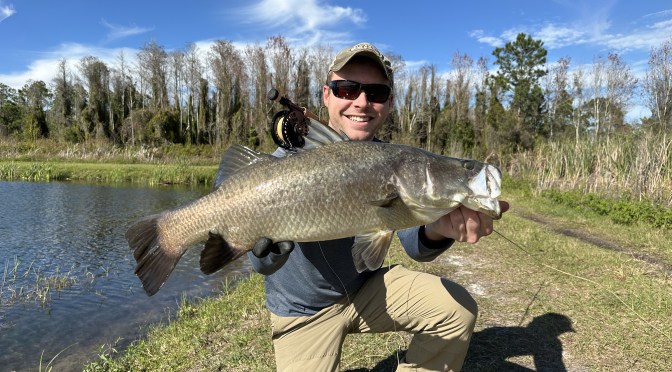
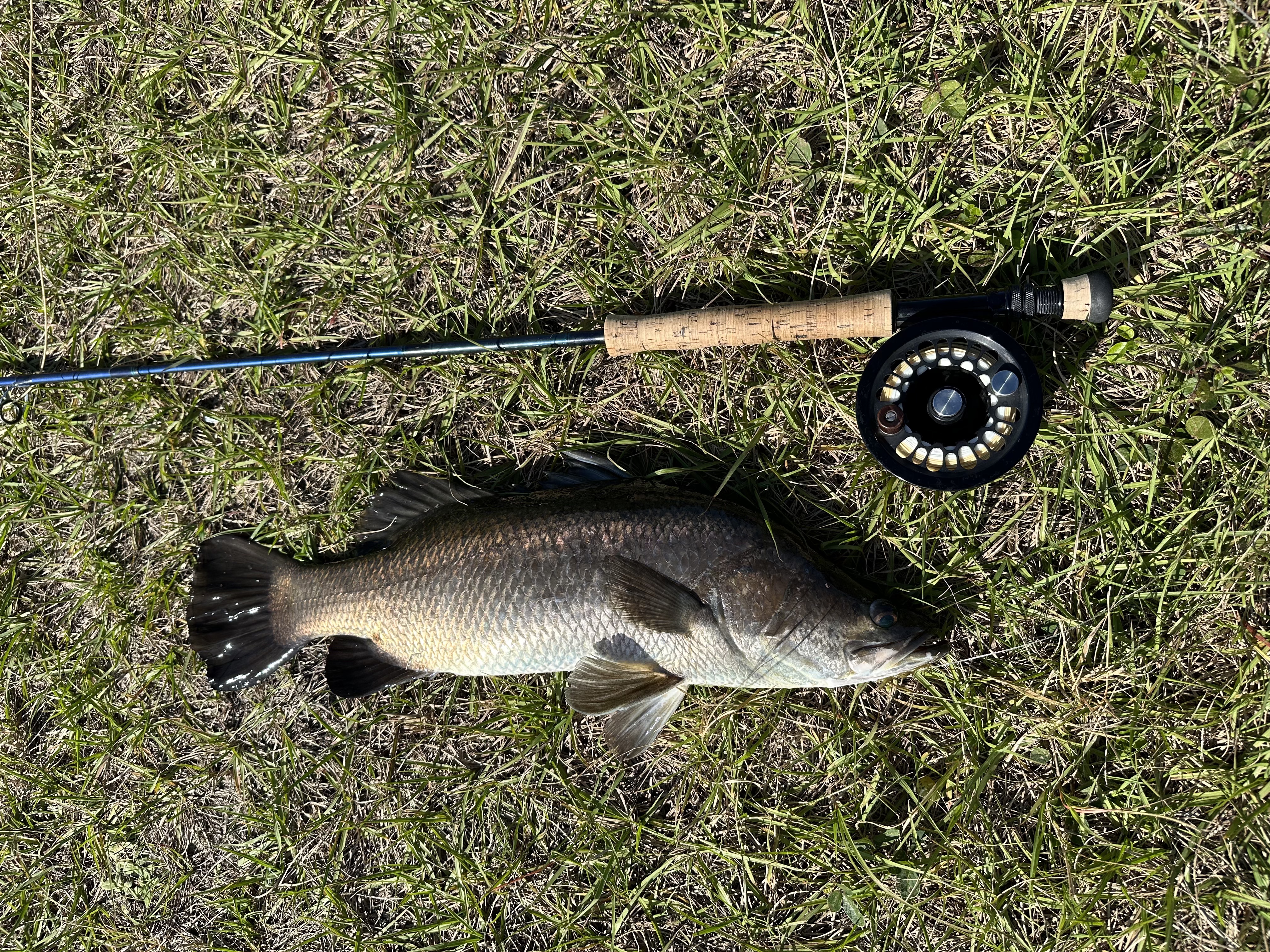
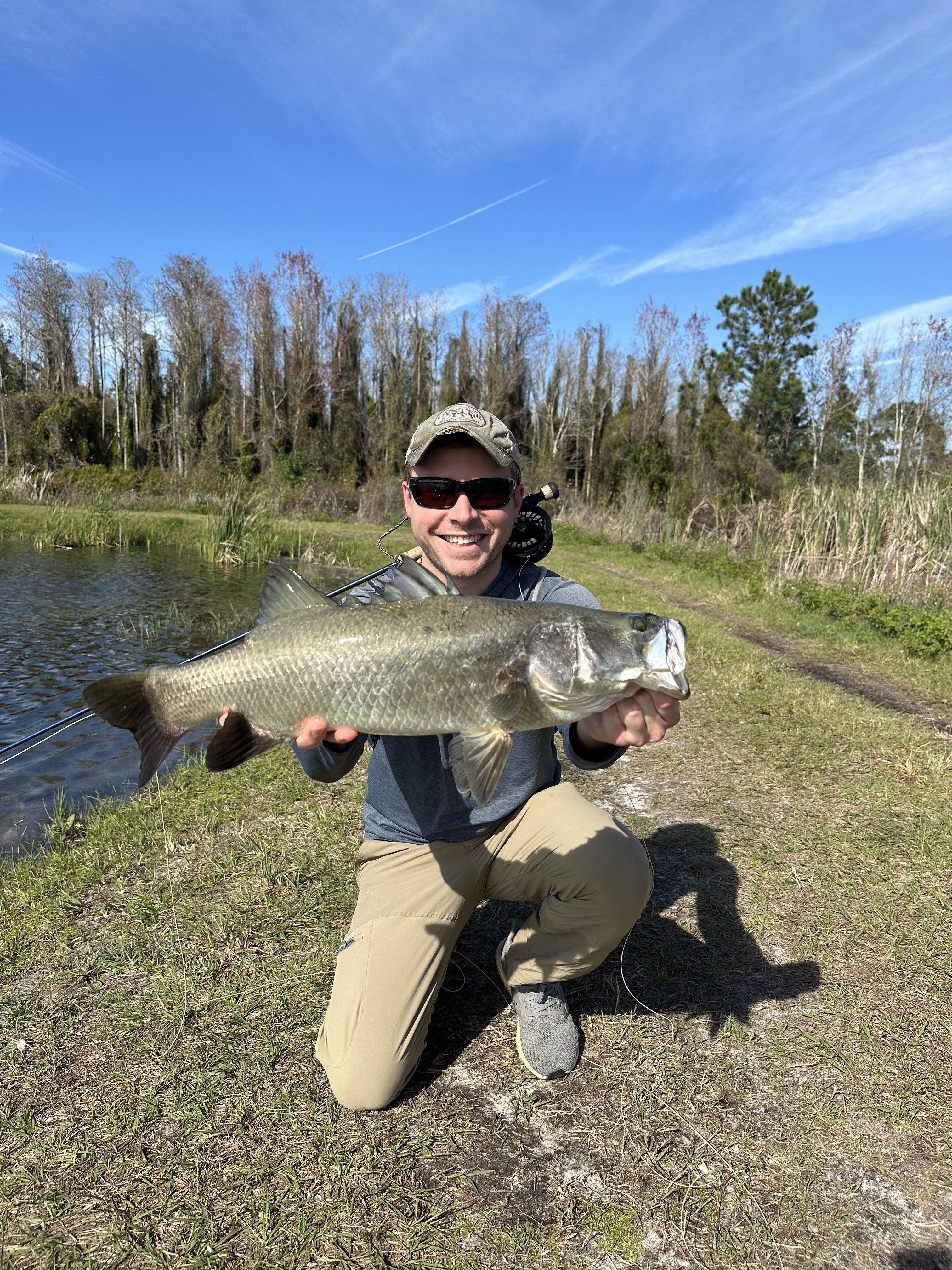
With all of that said, let’s hop into the 2024 adventures by discussing fishing for Barrramundi in Osceola, Florida. That’s right…Australian fish in Florida! This was hands down an opportunity that I wouldn’t have ever thought would exist in the United States, and I knew I had to make the time and effort to check it out.

Although the fishing was objectively not very challenging (as tons of fish were present), the fights, conditions, and getting eyes on a new species made it one to remember. These fish are here because of an outfitter that legally has been able to stock them for fishing and other commercial purposes. This is the only outfitter in the United States that has these fish.

Only about a 45-minute drive from some work I had in Orlando, I arrived to the property unsure of what to expect. The weather was abnormally cold for Florida, and the outfitter gave me a heads up that it could be a challenging day as these fish really need wam water to get amped up. With that said, I rigged up my 8-weight rod and had an assortment of strong-hooked flies that I typically use for saltwater ready to go. Within the first ten minutes of throwing a white bucktail fly, boom…

Joe Petrow – Barramundi
The take of these Barramundi is honestly something that I would compare to a tarpon. They fully engulf the fly with a huge open mouth, and when you strip set, it feels like you are trying to get a hook into a concrete block. With a few major jumps mixed in, these fish really are an ultimate game fish and I was extremely happy that I made the time to come check this place out. The fish were definitely a bit lethargic from the colder water (and the flies needed to be fished very slowly but yet sporadically to entire an eat), but was able to land more fish than I could count. The biggest trick to the day was making sure to have heavy enough line (straight 40 pound fluoro) and a strong wide gap hook to keep the fish on. The majority of the fish were between 8-12 pounds, but larger fish do exist that can be conquered in deeper water during the spring and summer in warmer weather. As for flies, anything that was white and 3-6″ inches long seemed to really be the ticket. As shared earlier, the sheer number of fish on the property makes it inevitable that success will be found, but adjusting to the conditions absolutely made it a much more productive day.

Sometimes it’s good to mix it up and go somewhere to get a pull on the line! This is a great example of that – I mean you can’t really ask for a better way to spend an afternoon in the middle of a colder January.

Tight lines!

Joe

The Others

For anyone that is a sports fan out there, you are probably familiar with “the others” concept when it comes to a team. For those that might have absolutely no clue what I’m talking about, “the others” is a term that is used to explain role (or bench) players on a team that are still needed to win games. Although “the others” are not the all-star, multi-million dollar, or biggest players that will sell out tickets in the stadium, they are often times the deciding factor in the outcome of any given game (as they will always swing the score by a couple of points, and bring the element of surprise along with them).

When it comes to fly fishing, “the others” are the awesome fish you catch that you were not anticipating to show up and that can save the overall day by making their presence known. For those who have read this blog, you know that I am slightly obsessed with catching all different kinds of species on the fly rod. I firmly believe that fly fishing should have no boundaries when it comes to the type of fish being pursued, and I also believe that many times people won’t pick up fly fishing because of incorrect assumptions that they live somewhere that isn’t ideal for it (i.e. “there are no trout where I live so I can’t fly fish”).

For capping off 2023, I thought it would be fun to highlight some of “the other” fish that I ran into this year in hopes of encouraging line to be thrown wherever you might be. By no means were these all of “the others” (as most outings are accompanied by surprise fish), but these were some coming to top of mind!

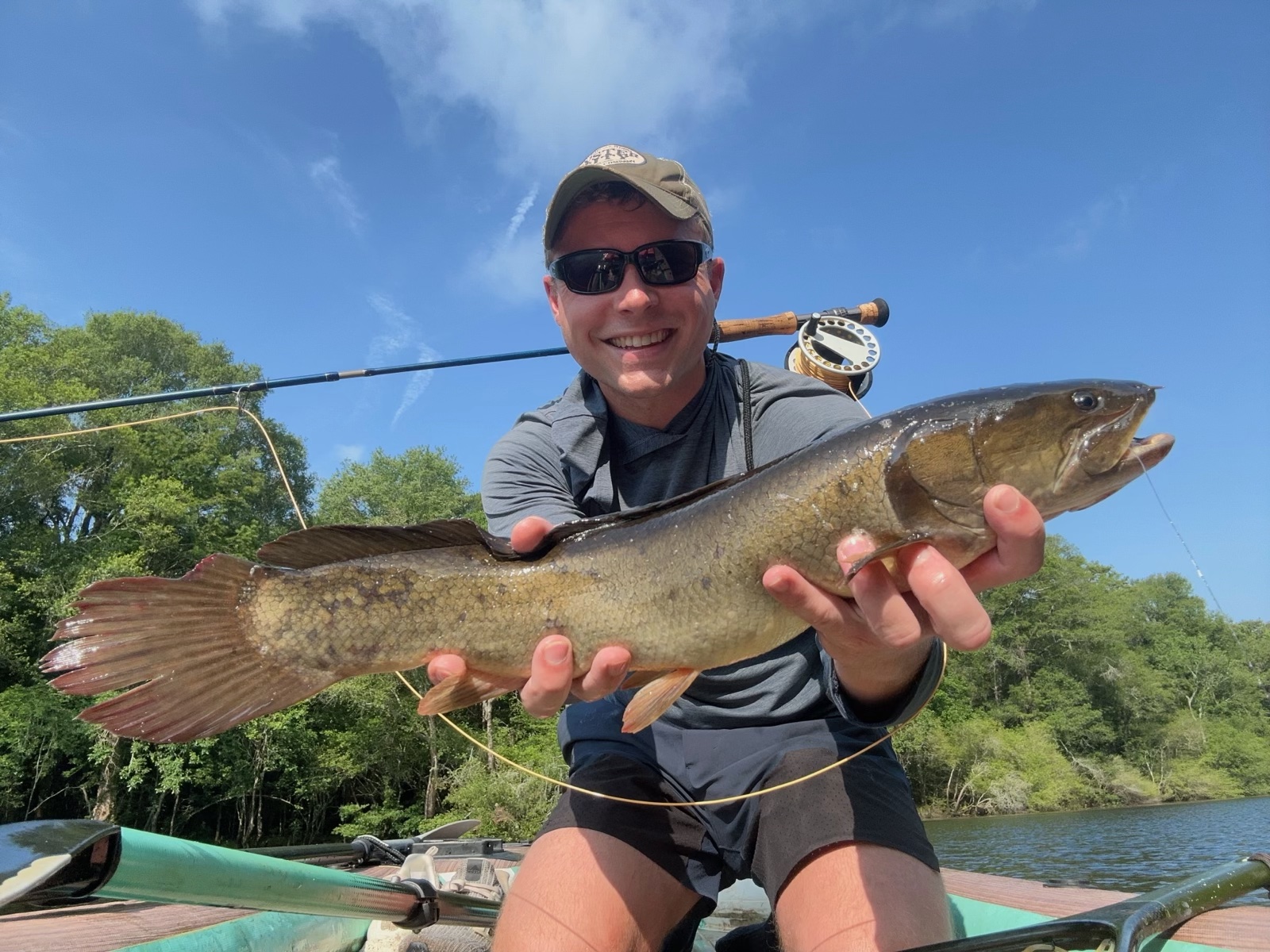
Bowfin – A fan favorite of mind. Prehistoric and pull like crazy. On this day I really was fishing for anything, but this guy made the morning special.

Joe Petrow – Bowfin
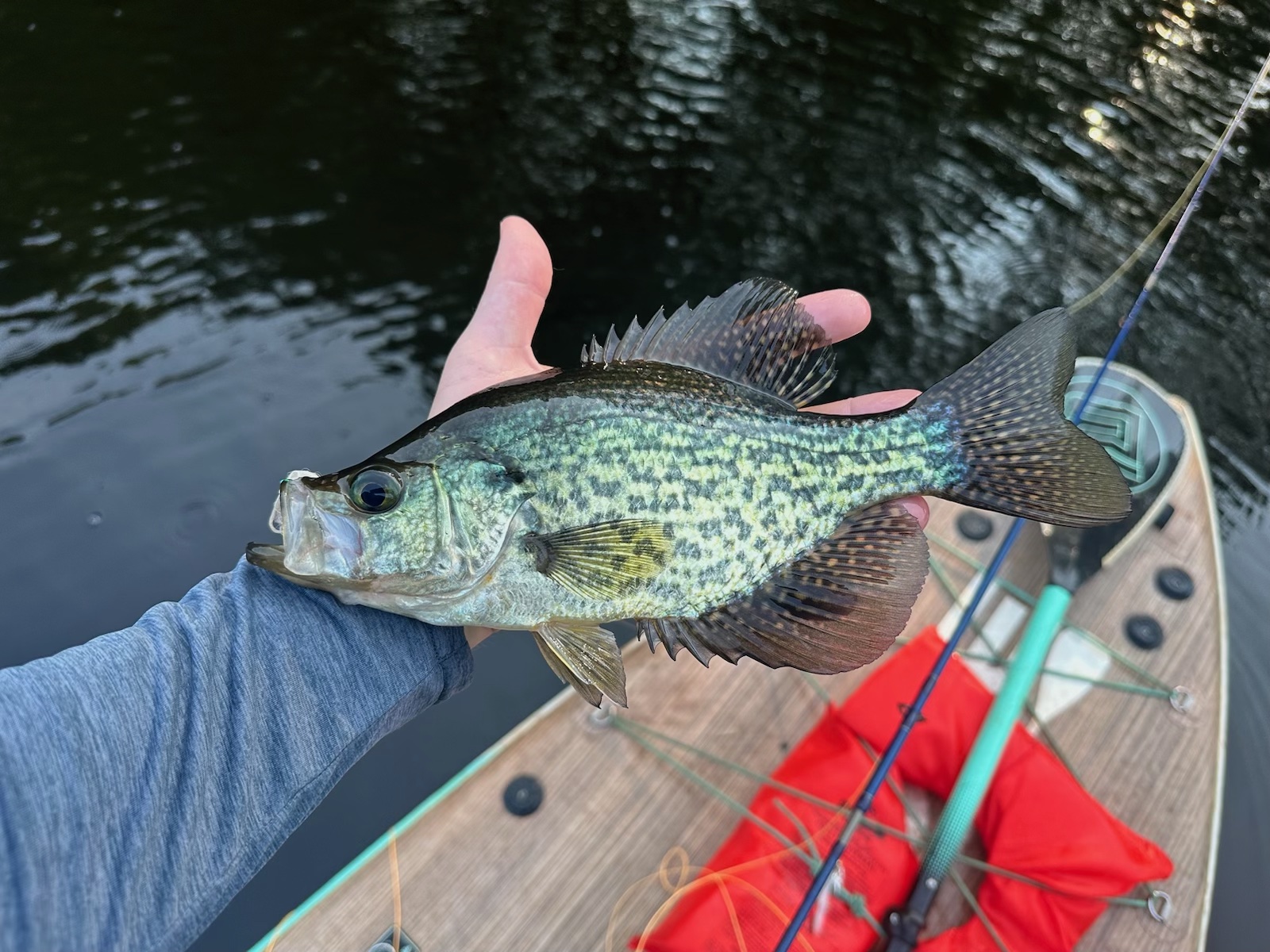
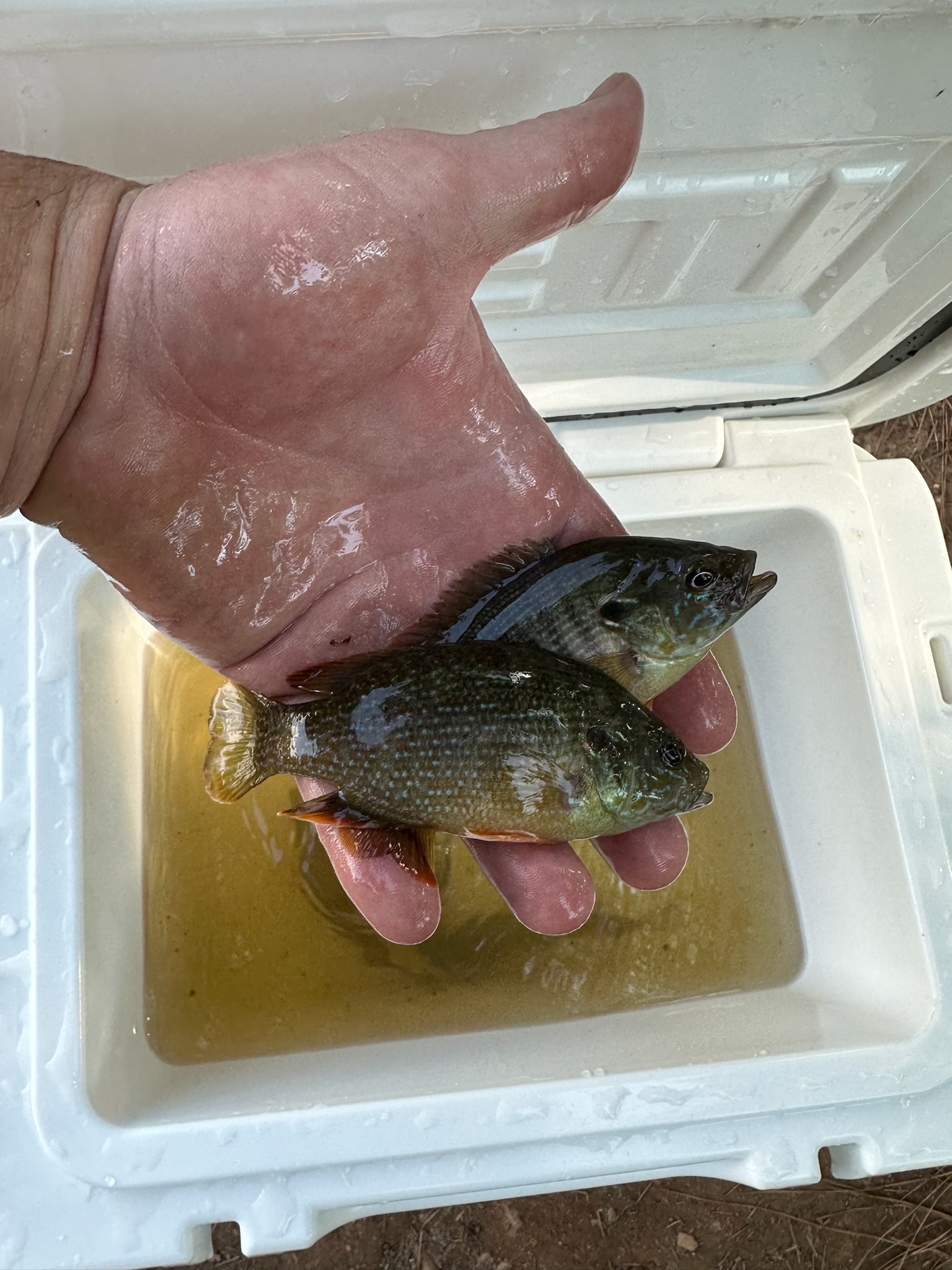
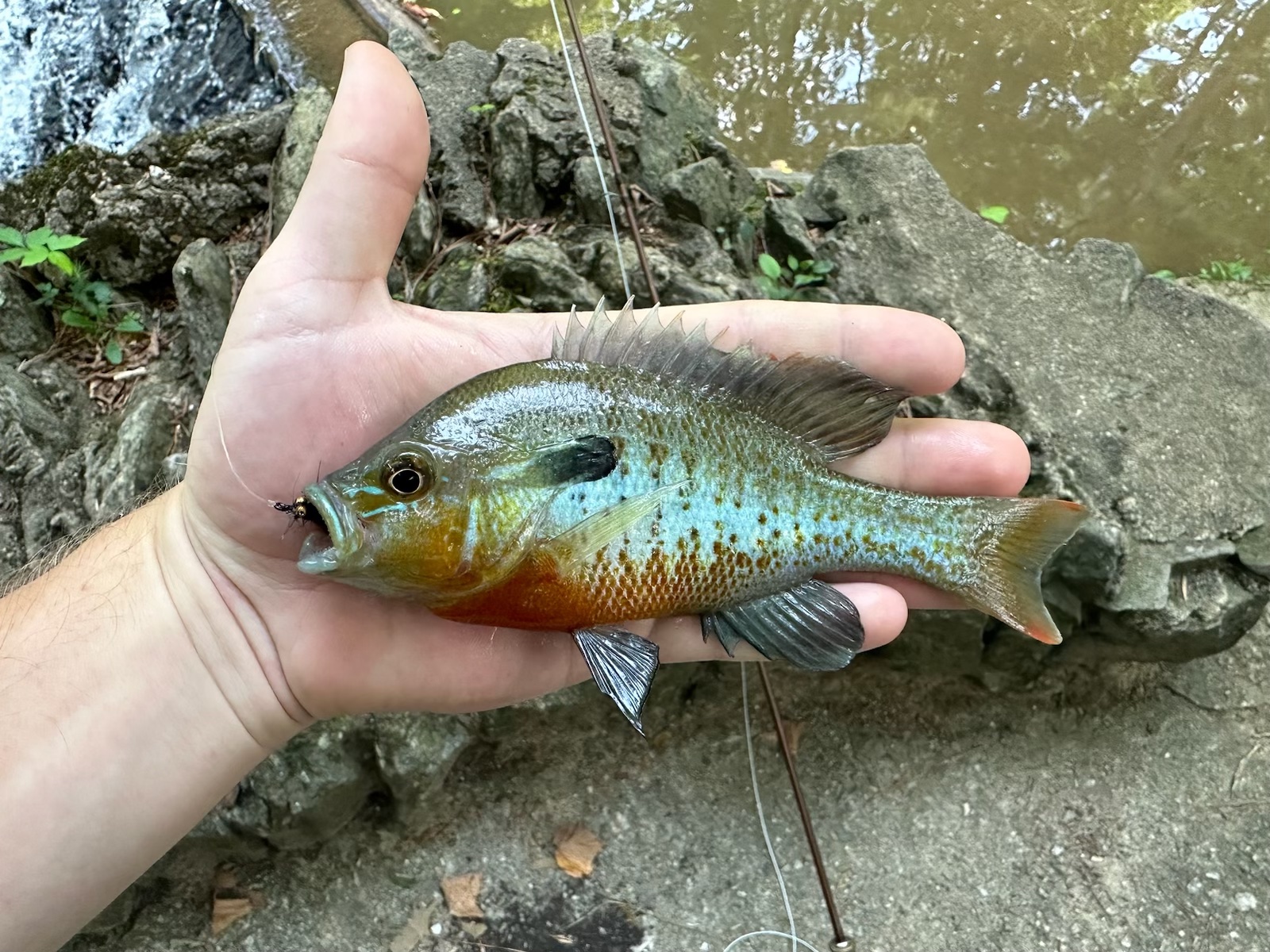
Redear Sunfish, Bluegill, Crappie, Green Sunfish, Redbreast Sunfish (in order below) – Sunfish in general are some of the most under-appreciated fish due to their size. Bluegill and Crappie are specifically are one of the most common freshwater fish to find in the US. Always fun running into these guys on a day of searching for Bass on a lake, or throwing small flies into creek systems just to see what is around. I even did some fish “saving” this year as was finding a ton in drying up pools of water at the end of the summer. Redbreast Sunfish are really unique from both a geographical standpoint and their overall looks.

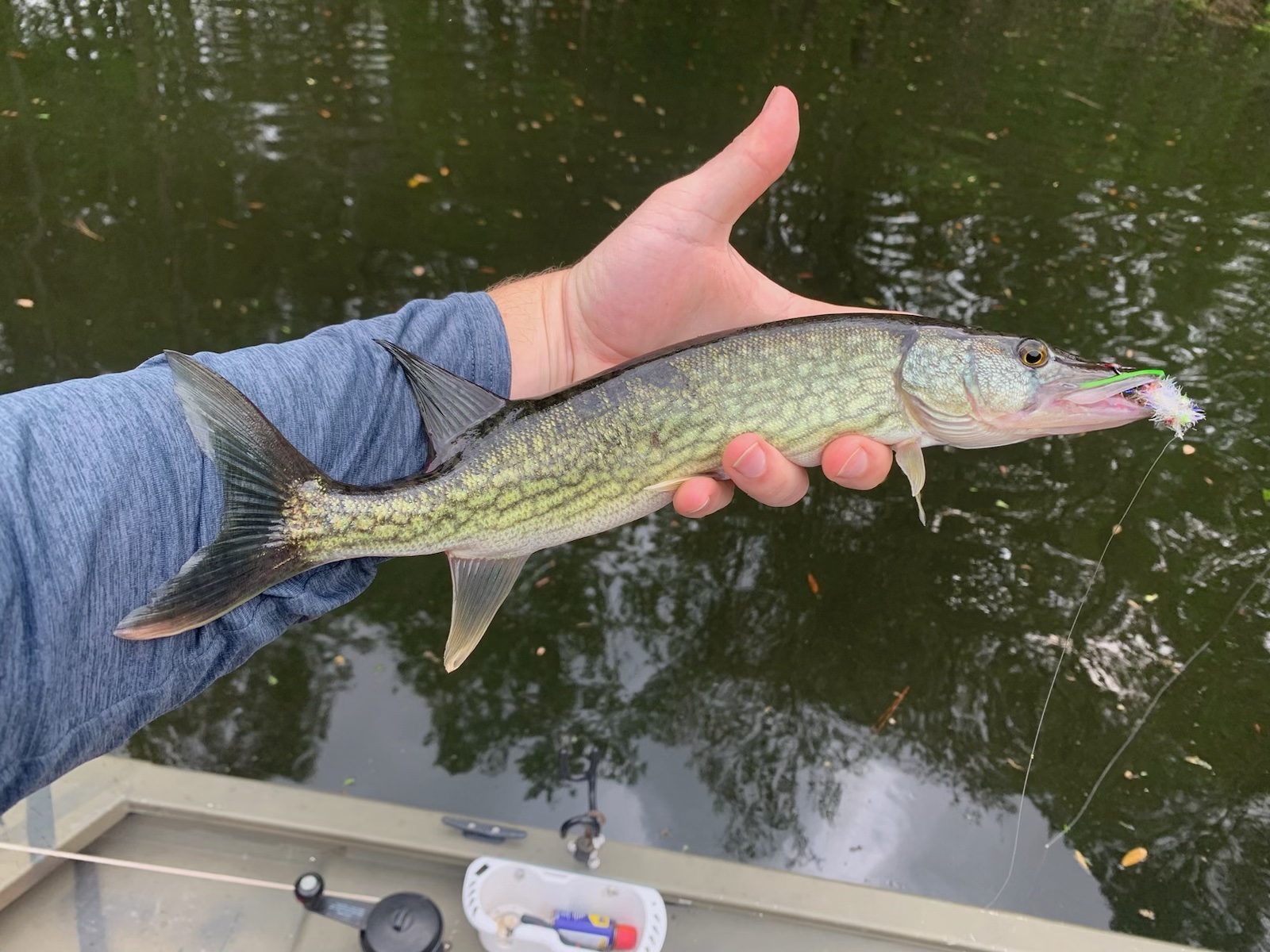
Chain Pickerel – known also as a Slime Rocket, Ditch Pickle, or countless other names. These guys attack and eat flies like a baby Musky or Pike, and get way too much hate considering how fun they are to catch and how good looking they are.

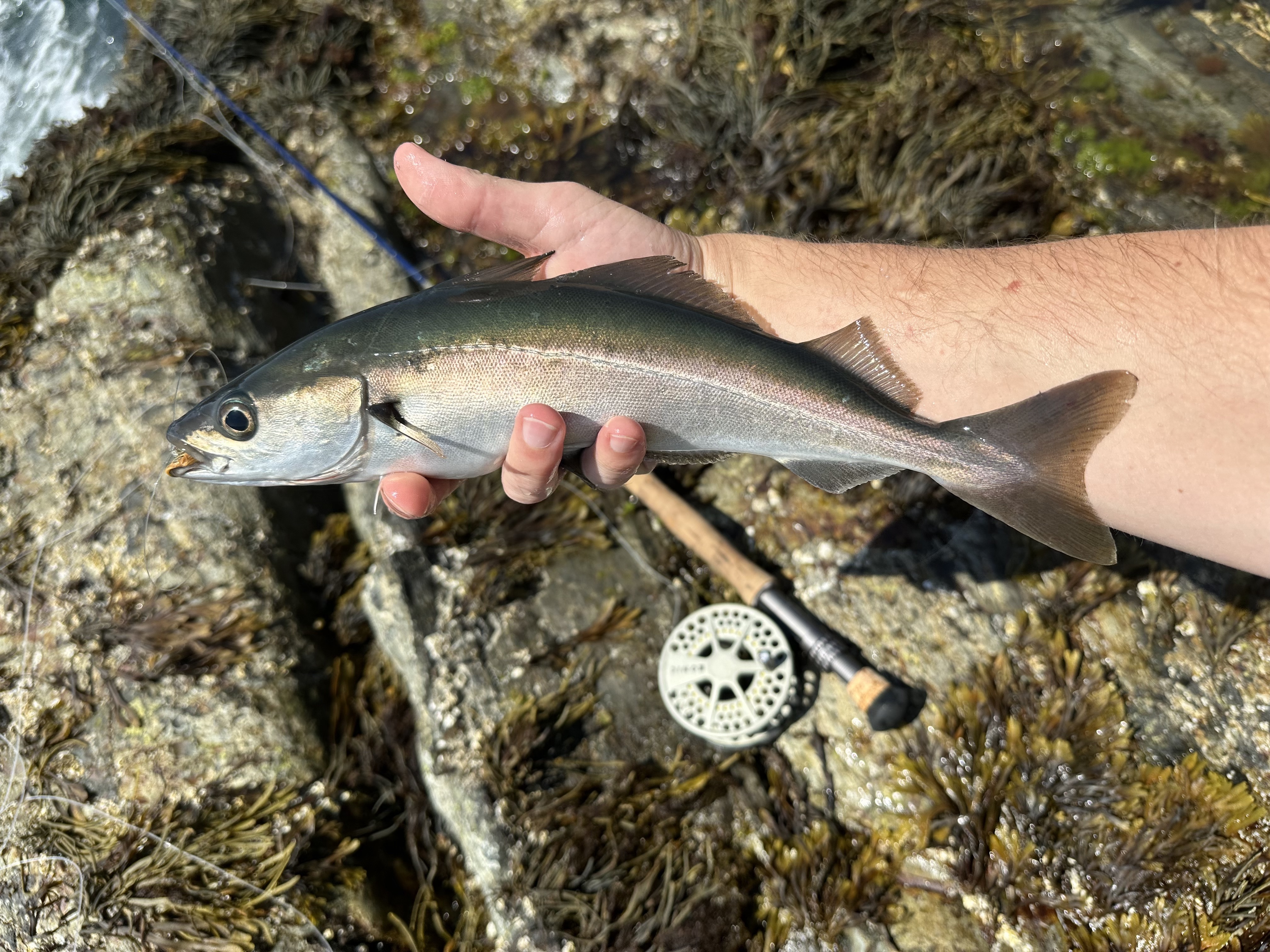
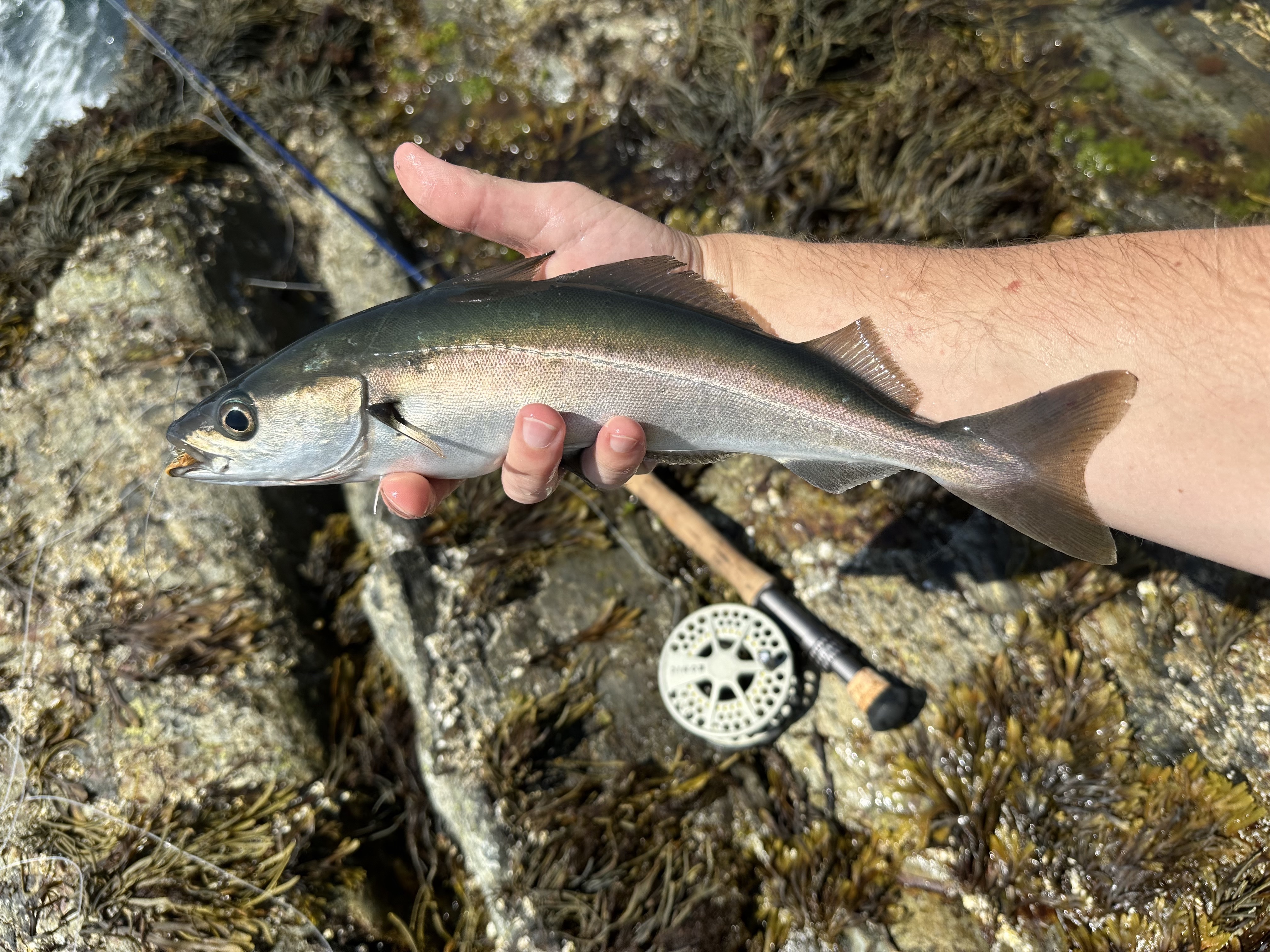
Atlantic Pollock – These fish are a hoot. Ran into a pile of them while Striper fishing in Maine, and they kept the action steady in between Stripers. They pretty much will hit anything small and yellow it seems!

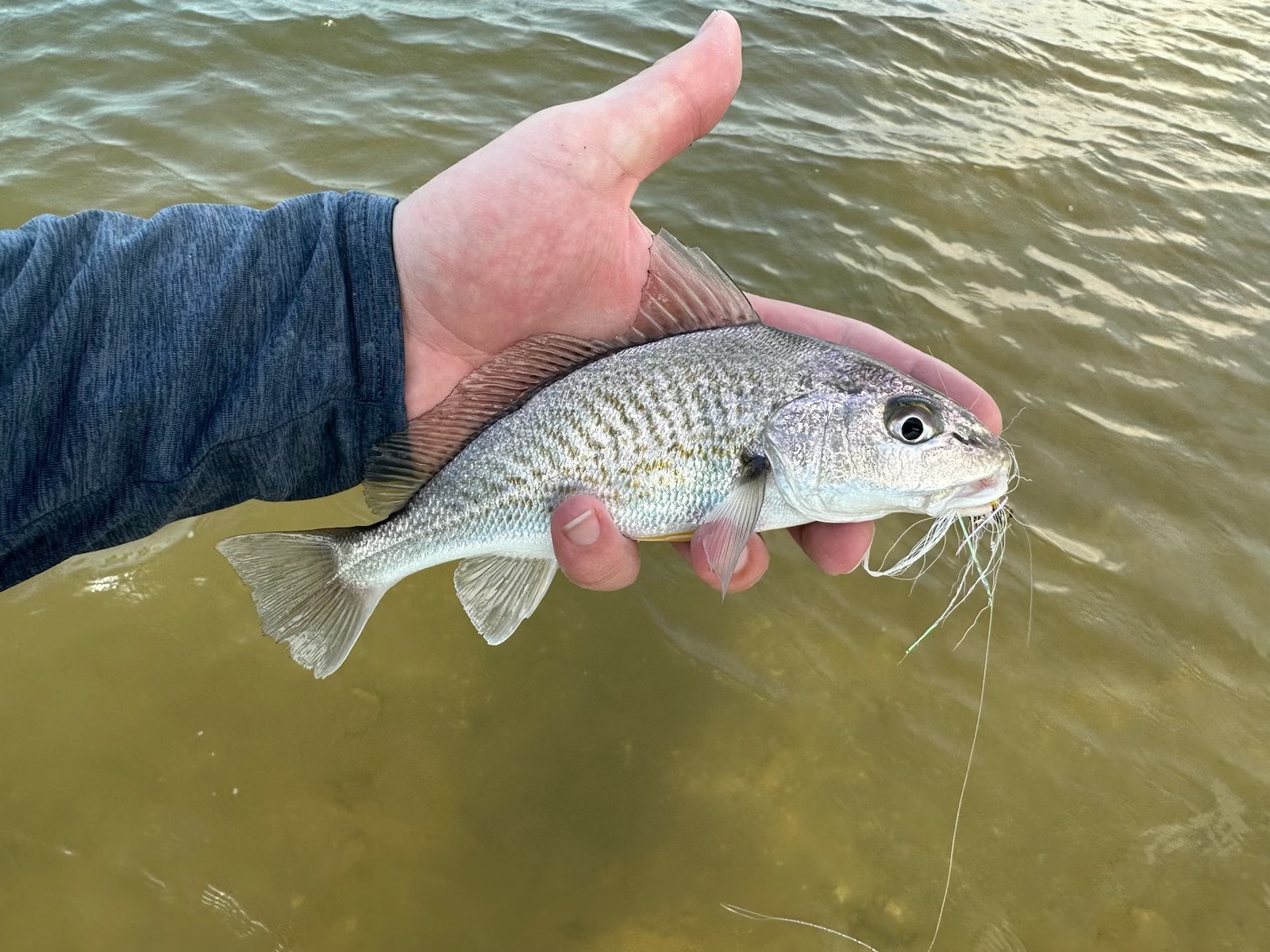
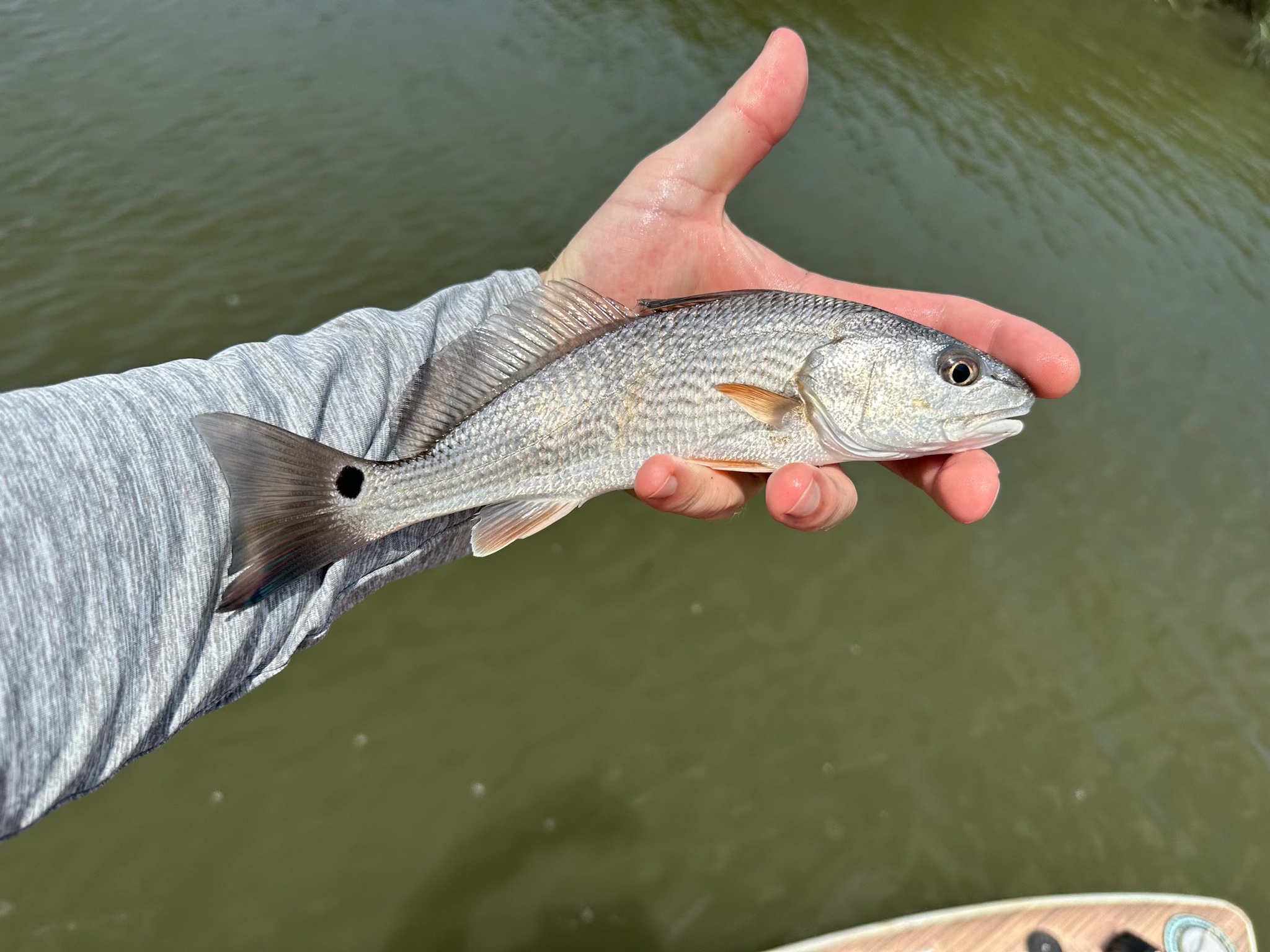
Croaker and Baby Redfish - Was able to get the paddleboard out on some flats for a hour here and there on two separate trips this year, and these guys made it worthwhile. The goal was to find some “big” Redfish up shallow, but the wind and dirty water had other plans (especially challenging with no boat). Regardless, these fish showed up and we appreciate the cooperation!

Bottom line here – appreciate what you catch. Every single fish is a “nice” fish. No need to discriminate or downplay, especially if you are putting the work and effort in to get out on the water (no matter how much time you have or what the conditions are).

Tight lines as always!

Joe

Carp – Never Out of Style

Surprise, surprise, we have another post about carp. For those of you upset about it, not sorry. For those of you happy about it, I love you.

But for real and on a serious note, this past year was the definition of *elite* when it came to the carp fishing. Not only did the local waters fish excellent and produce some of our best fish to date, but I also had the opportunity to fish the famous canals around Scottsdale, Arizona and check out the carping scene there.

Let’s start with the Arizona carp. For starters, was there for a bachelor party weekend not focused on fishing, but still made it happen in less than desirable conditions. Best case fished for 2-hours each morning (early) as the hangovers were wearing off for the rest of the gentlemen and scholars at the AirbBNB. It was an unseasonably cold weekend in Arizona, but the fish did not seem to mind at all.

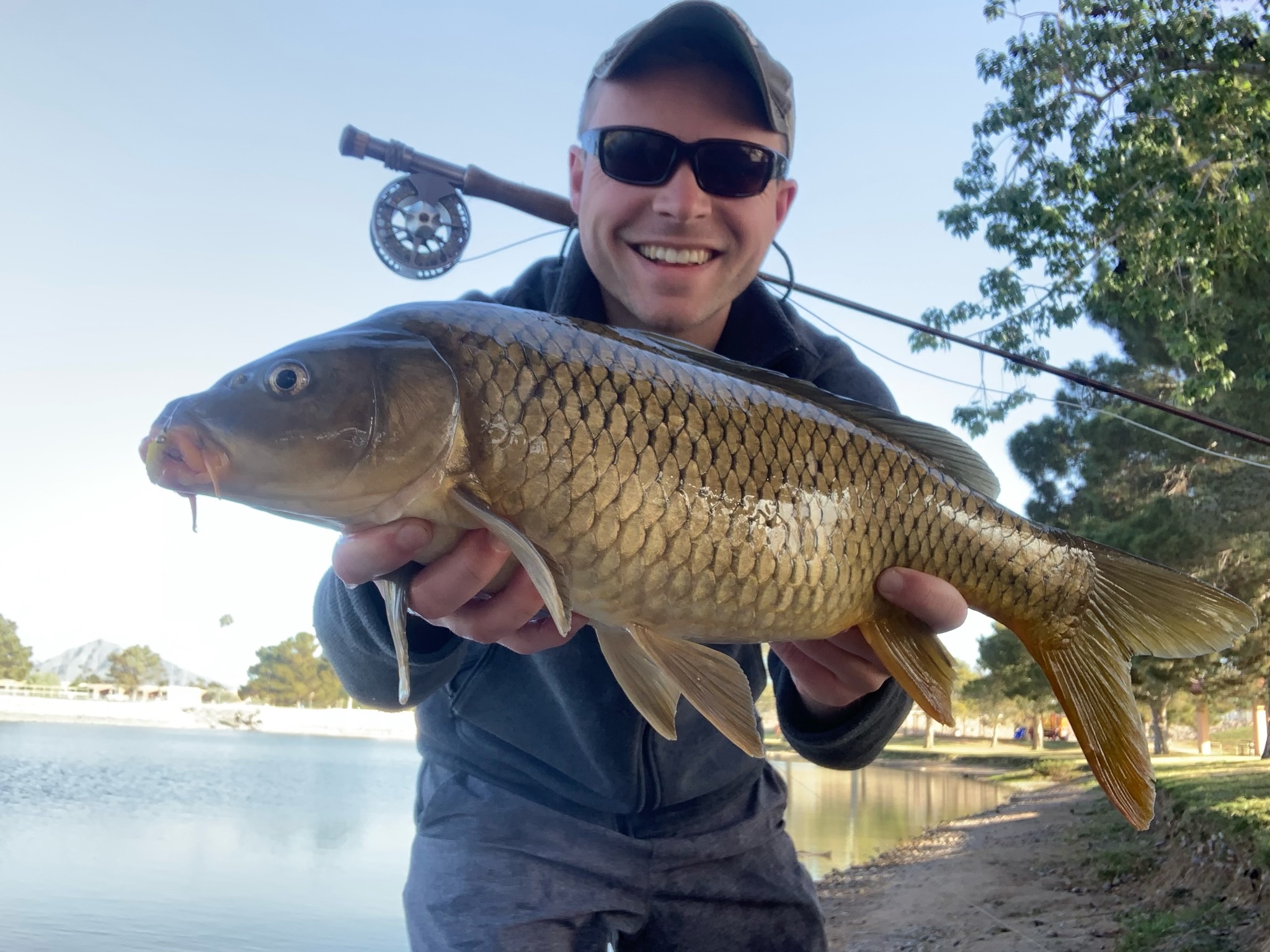
Not having fished in Arizona before, my best friend was Google Maps, and Uber’ing to a local park that had a handful of canals/ponds surrounding the premises proved to be the move . After about a 10-minute somewhat uncomfortable ride with the driver not understanding why I had a fishing rod with me, I entered a quiet residential park with practically no one else there. Literally upon exiting the vehicle and rigging up my 4-piece 6-weight rod, I was already seeing carp surface in the water around me. I also noticed some creek channels extending out of the ponds, to which I chose to explore those as the water was shallow and clear, and saw some fish moving. Within my first 10-minutes, I already was hooked up to a nice carp on one of my specialty home tie flies. Per usual carp fashion, the fish put up a great fight, and I was able to land a second fish shortly after in the same creek. The biggest fish of the morning came from one of the ponds themselves - a fish sunning in maybe 3-4 feet of water. Drag and dropped the fly right on its face, and bam. What a morning and one of the photos I was able to takee from it below:

As for the local carping this year, it continued to be one of my highlights for the summer. Although there were the recurring challenges with river conditions and clarity, when the water was clear and the sun was up, the fishing was unparalleled. Similar to last year, I found that late April and May produced the most fish (as they provided the largest schools I have ever seen – I’m talking 30+ fish in each school), but that fishing remained consistent until early September.

Joe Petrow – Carp
Joe Petrow – Carp
Joe Petrow – Carp
As always, the most effective way of catching these fish was on the micro skiff/stand up paddleboard, and exploring the backwater creeks off of the Chattahoochee river. One “newer” positive this year was that I caught more fish super shallow – i.e. less than a foot of water. Typically I am fishing for floating fish that are still over water that is 10+feet deep (which can be exceedingly challenging with the fly rod, as they can disappear upon desire), but now have some waters where it really is a true “flats” feel where wading is even possible if desired. One area I look forward to testing more in 2023 is trying to figure out the Grass Carp – there are a plethora in the river system that I fish, and although I’ve had some minimal luck, would be a ton of fun to figure out how to consistently hook into these fish. Have some plans to test out dry fly scenarios more with lighter tippet.

Was fortunate to have several outstanding sessions for the carp over the summer, and below you will find some of the best/highlighted fish we ran into. Overall, the favorite flies of the summer consisted of small damselfly nymphs, cottonseed patterns, as well as the occasional “wormy” looking thing when the conditions were right.

Joe Petrow – Carp
Joe Petrow – Carp
Joe Petrow – Carp
Thanks for the read and hope you are searching for some carp near you in 2024!

Rock Hopping for Stripers

Many times later in life, you will discover something new and so valuable that it will cause you to stop and think “I wish I would have know about this years ago.” For fly fishermen specifically, I believe this happens even more frequently, as there are so many new waters to fish but limited time/opportunities to get out there and make it happen. For me specifically, I’ve had plenty of my “I wish I would’ve been doing this sooner” moments when it comes to fly fishing for Striped Bass up in Maine.

For a little background, my first trip to Maine was less than 2 years ago. Upon arrival, I was immediately amazed with the amount of water, nature, and overall beauty that the state had to offer. After this first visit, I vowed that I would at least make it a point to return annually, and fortunately for me in 2023 this consisted of some prime DIY opportunities to catch some Striped Bass.

This year we visited Maine in May, which turned about to be great from both a weather and fish perspective. We were fortunate enough to stay on a resort near the cliffs of Ogunquit, where the water was as royal blue as it comes. Immediately upon exploring town, I was investigating the water below the rocky bluffs for any big striper patrolling the rocks looking for a snack, and within a couple hours was finding fish.

Although I have not fished for striper to the degree of other predatory species, I have learned over the years (for both fresh and saltwater striper) that structure and moving water and key critical. The more rocks and deep ledges you can find, the better, and the more the current is moving, the better. On our first day in Maine this year, I found an area that had a heavy outgoing tide in clear water surrounded by rocks, and this led to my large clousers getting smoked by nice fish. Huge runs in the surf, backing making an appearance, these fish were an absolute hoot and made the blueberry beer that Maine is famous for taste better that evening. Successful results were yielded in just a couple of hours of fishing, and the next day produced more of the same in the same spot.

Joe Petrow – Striped Bass
As with many trips to special places, fishing is not always the main focus, so on the final day I challenged myself to try and find some fish near the rocks by the hotel we were staying at (rather than doing continued excursions out of town and completely going missing in action for the day). Luckily enough for me, there was some prime looking water where we were staying, and it was just a matter of waiting for the right incoming tides to make throwing a line worthwhile in the surf. Although navigating the rocks requires an immense amount of focus and attention (so that you don’t eat sh*% and slip), if you do it the right way you can find some amazing fishing opportunities.

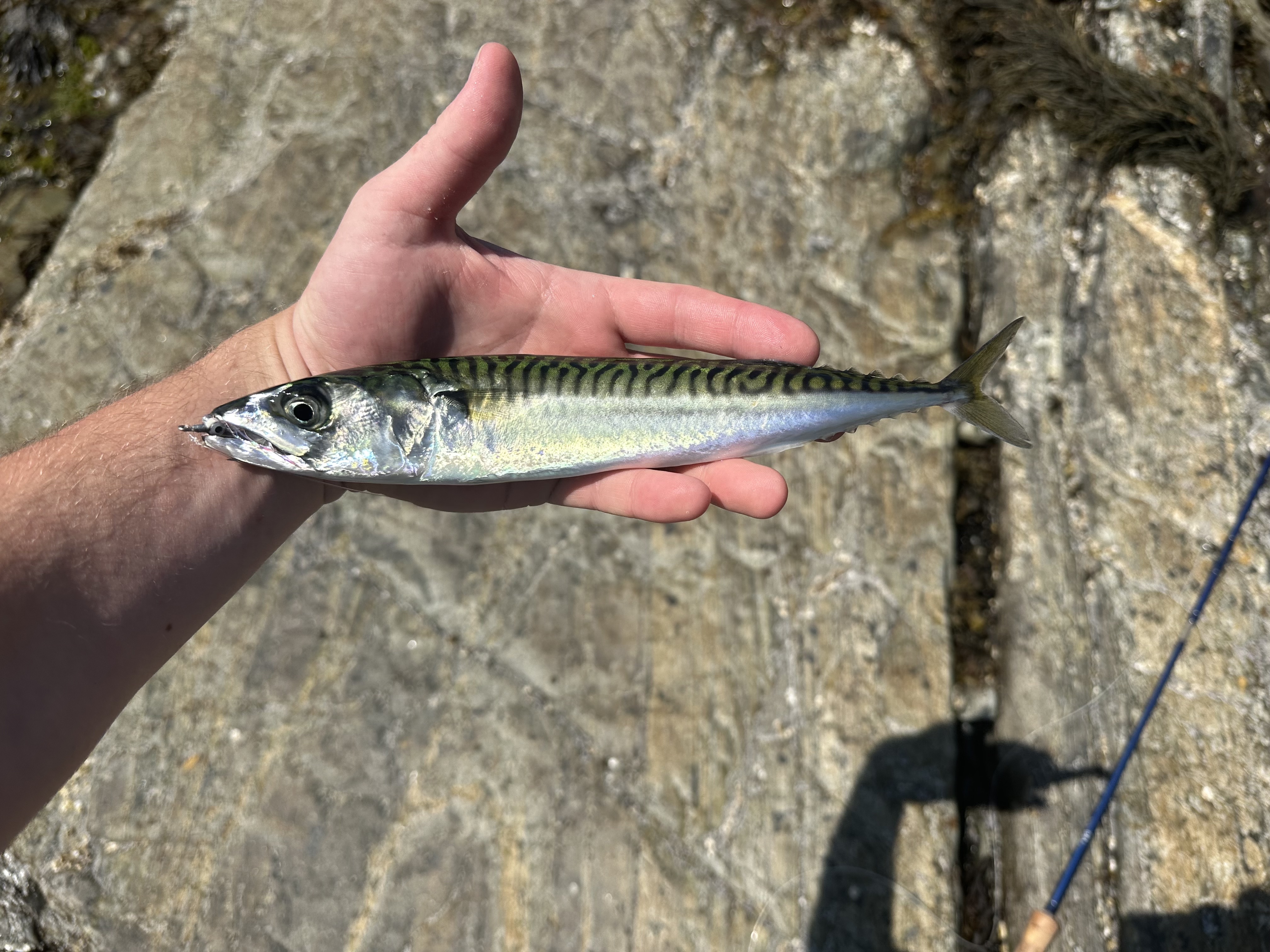
While investigating the water below the bluffs, I saw heavy movement by the rocks and was taken aback by my eyes – a large group of stripers on the prowl. Although none of “cow” size proportions, there were plenty of nice Stripers accompanied by a plethora of smaller slot fish. After dozens of throws with larger bucktail flies I had tied, I wasn’t getting any attention from these fish, and decided to downsize majorly to a small white clouser/deceiver type fly to see if that would do the trick. After my first cast with this, boom…fish on, and it didn’t stop. These fish appeared to be keyed in on extremely small baitfish right up against the rocks, and it was a blast watching the chase the fly all the way up to the rock walls before smashing it. Within a 1-hour window, easily landed 4-5 stripers, countless Atlantic Pollock, and a new species with the Atlantic Mackerel. Hands down the most difficult part of this was being able to safely land the Stripers for a safe release and quick self-photo opp. Overall, it was one of those evenings on the water that you won’t forget as the conditions, fish, and gear were all cooperating according to plan.
Joe Petrow – Striped Bass

Can’t forget about the other species that day:

Very much looking forward to returning to Maine this year, and who knows, maybe it will yield my largest Striper yet to come. Tight lines!

Joe

Keeping it simple with small-water Trout

If I’m being honest, this post might come with a few trigger warnings and might not be for everyone. Not because I’m going to say something R rated or get someone in trouble, but because I’m going to give my honest views on what it takes to find success catching trout (that are contrary to what most of the fly fishing industry would say).

To begin with and as followers of this blog know, I have very deep roots when it comes to fly fishing for trout. Growing up in Colorado and living in Utah for an extended period of time, this has been a staple throughout my life, and I’ve continued to enjoy chasing these fish no matter the occasion. All of this to say, I want to make it clear that I know what it’s like to fish for some of the spookiest trout out there – 6x tippet, 22 sized midges, deep indicator rigs, waders and boots required. I absolutely have done it and have caught fish this way. I also don’t shame it because to each their own, and sometimes catching that 20+ inch fish requires a mid-winter small nymph in some deep water. BUT…I genuinely have found over the years that the best trout fishing comes when I can avoid all of these things, and 2023 had some great examples of this.

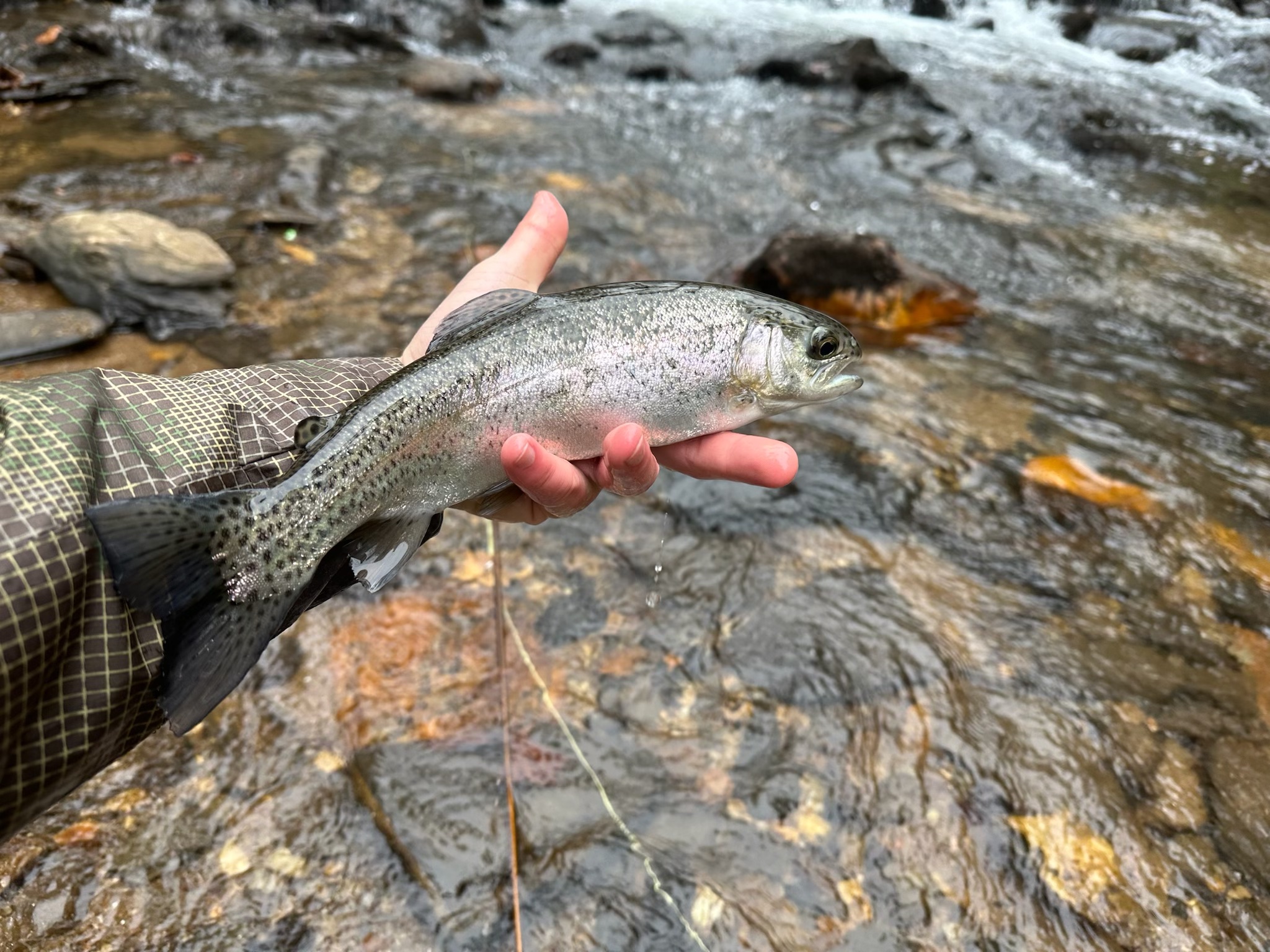
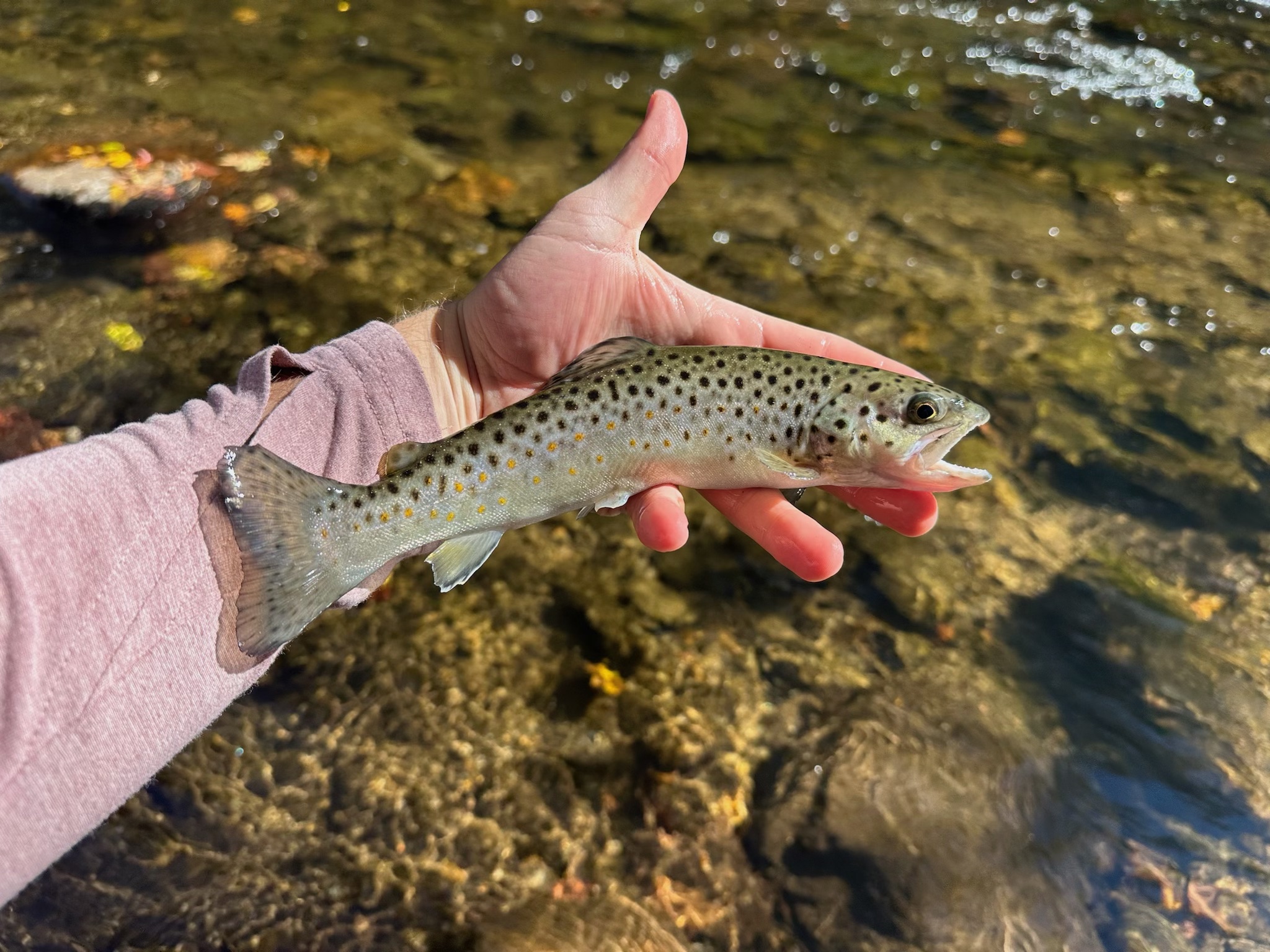
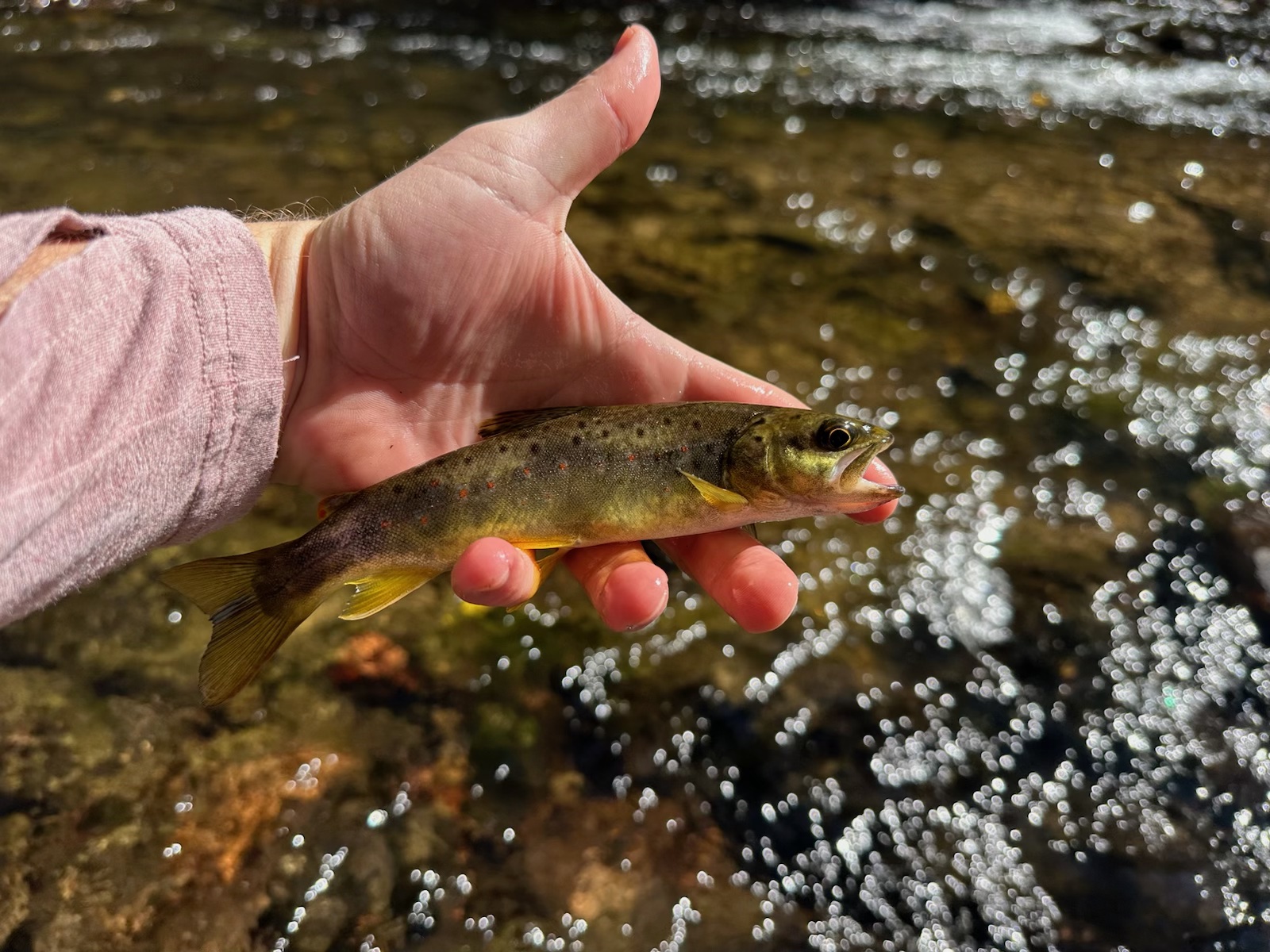
For starters, I think that with a 5-weight rod, 4X leader/tippet, and 3 types of flies in your box, you can have success. I put this to practice this year while visiting both the mountains of Colorado and Georgia. Had some beautiful creeks right in town that I wanted to explore and see if the fish were active, and was able to find success by keeping it simple. All I essentially fished with were small brown/gold wooly buggers, prince nymphs, and royal wulffs (in case the fish were looking up). In these small mountain creeks, the fish are extremely opportunistic with pocket water. By pocket water, I’m referring to any calmer/slower areas of a creek that are usually directly behind a fast moving current, rock, or other structure. These pockets are typically no more than a couple feet wide in these types of creek, but usually will hold the best fish around as they wait in an ambush point for passing insects and bait fish to eat. As for me this year, the majority of my success came from fast stripping a wooly bugger through these pockets of water, and getting ready to strip-set if a fish came to grab it. Often times this is visual and very exciting, so always be ready for a take you might see the action taking place before feeling anything on the line.

When the wooly buggers weren’t the ticket, I would do a quick dry-dropper set up with a royal wulff and prince nymph. This allowed the fish keyed in on insects to feel a bit more comfortable, and on occasion provided the historic rising trout image that the world has come to love.

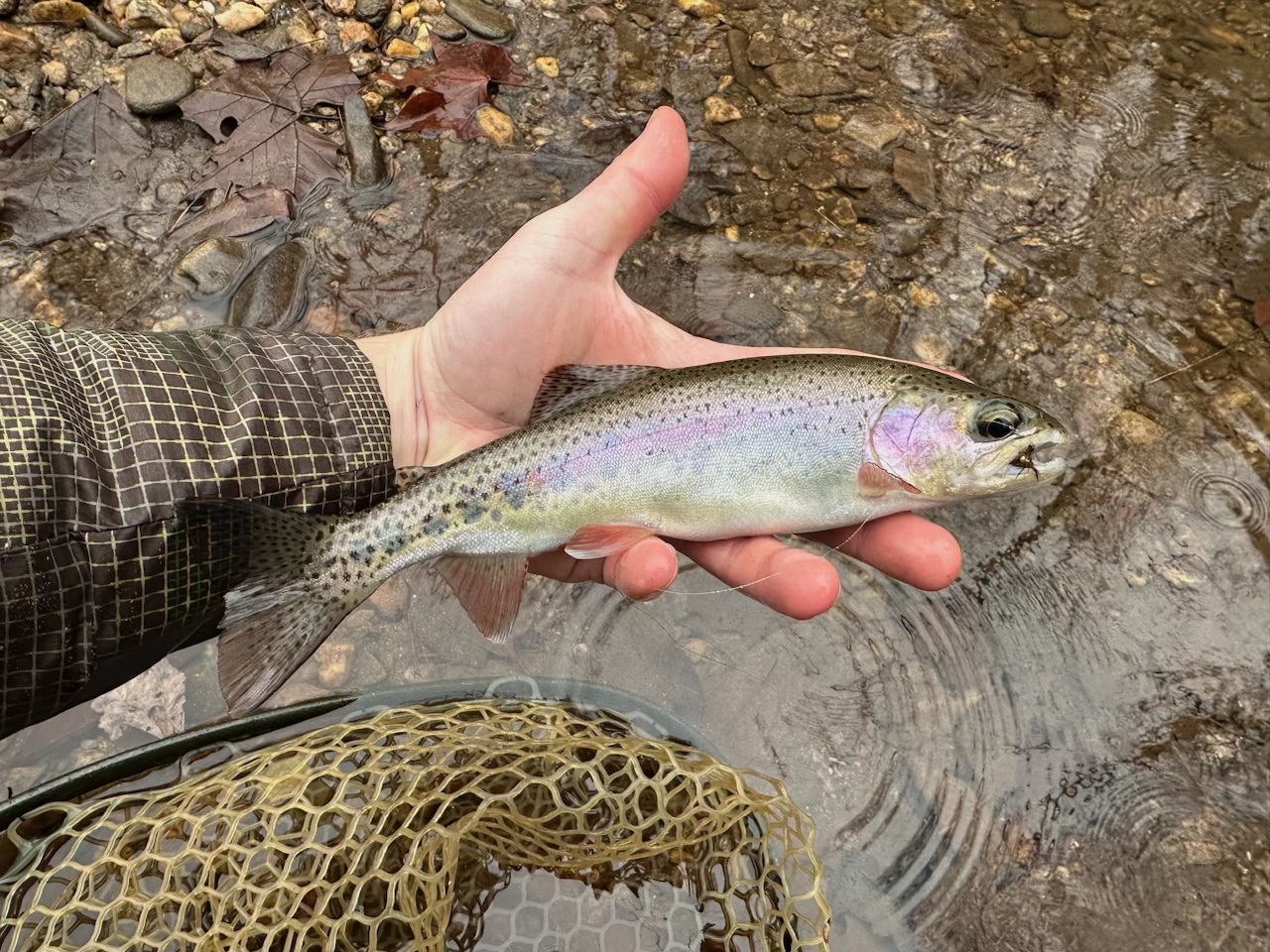
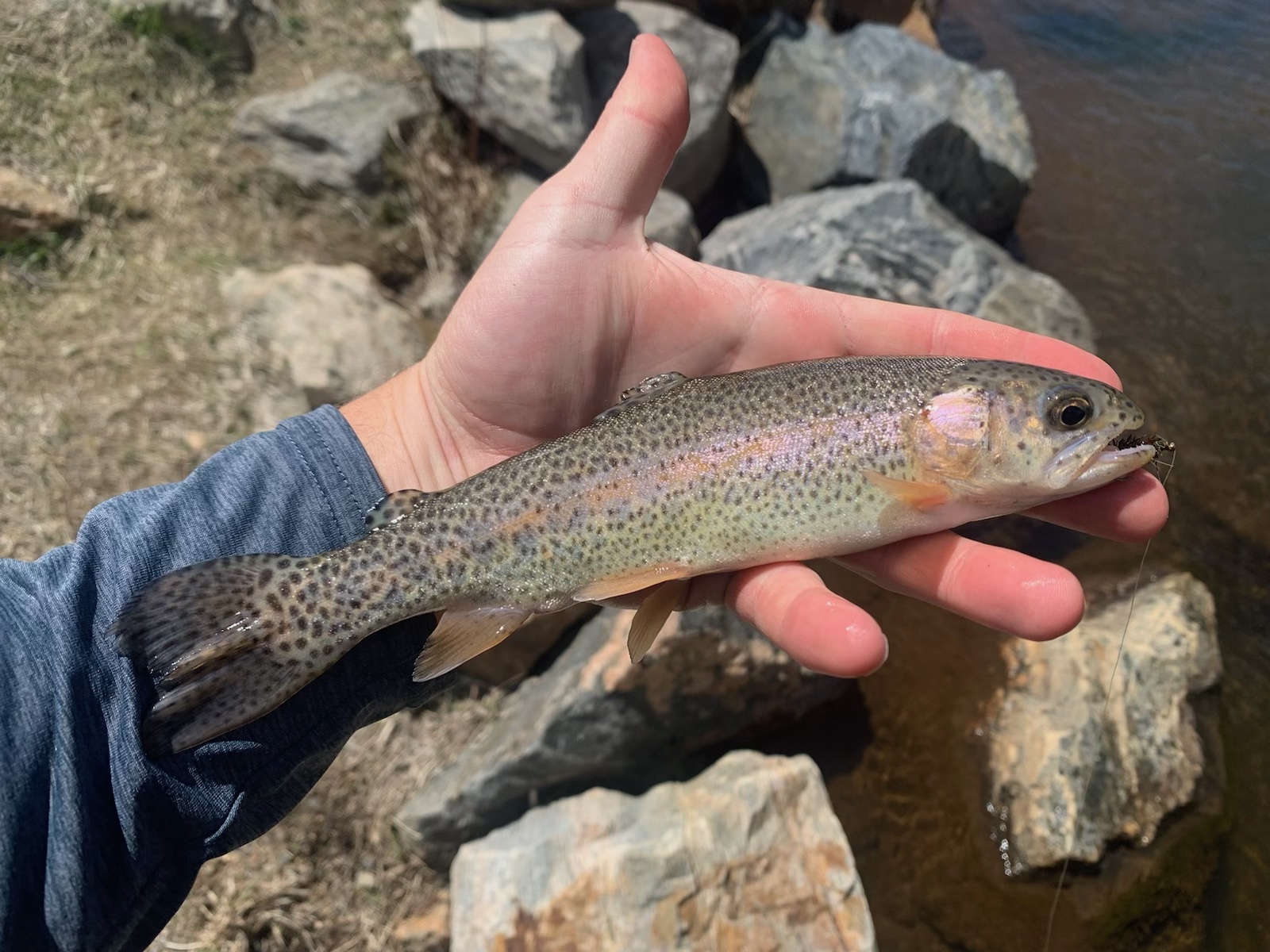
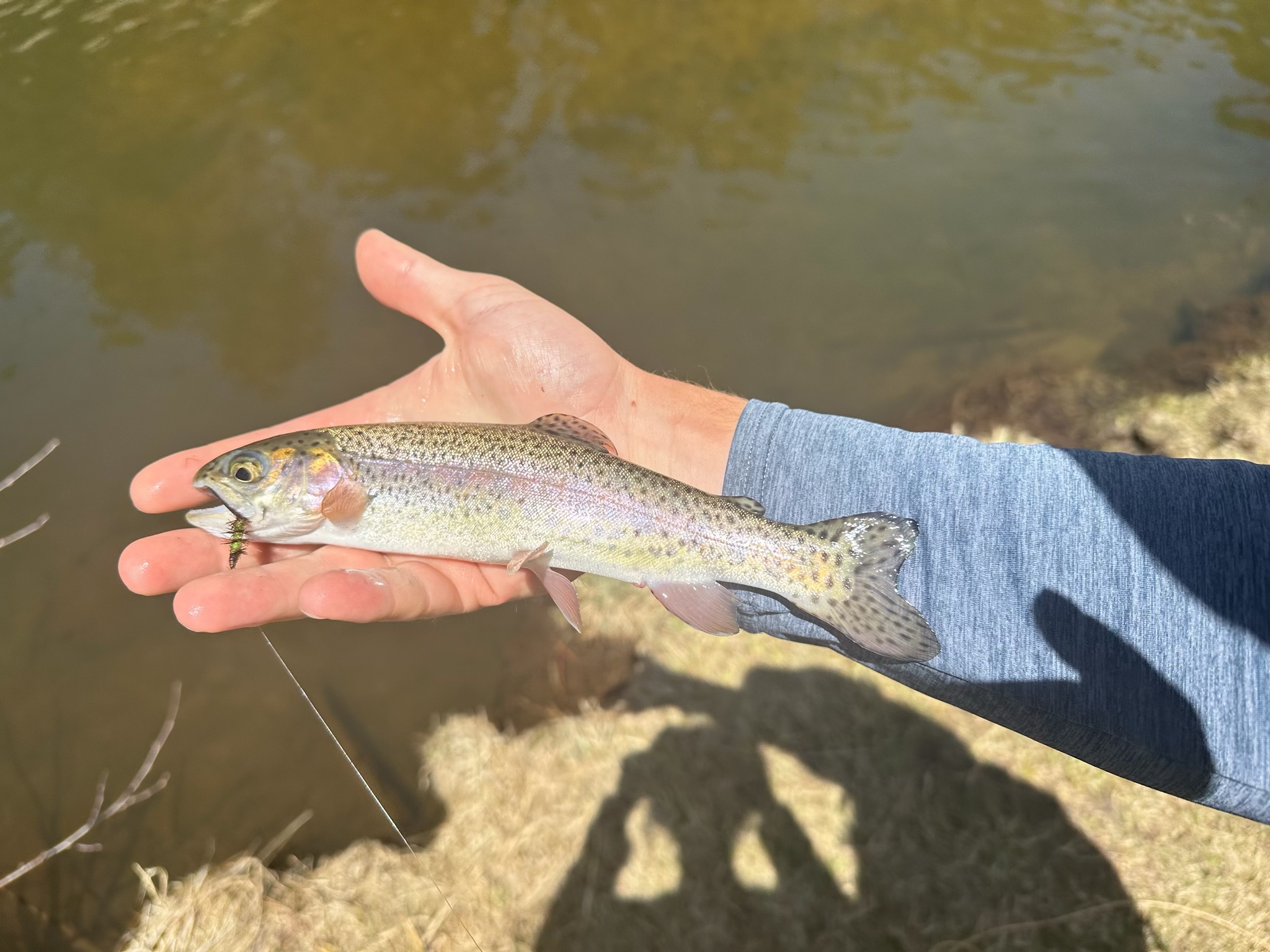
Although I did not spend much time this year on chasing any “bruiser” trout specifically, below are a handful of the fish I brought to hand “keeping it simple this year”. My goal in documenting some of these simple strategies is to encourage myself and others out there to always give it a try when it comes to trout. Sure those float trips are a blast (some of my favorite memories fishing come from floating thee Green and Colorado rivers), but sometimes all you need is a moving current and a few flies in a zip lock baggy. I also at times feel like some people will be hesitant to even try catching a fish on the fly because they think they need all the bells and whistles when it comes to gear to even have a chance. We are all for making the most out of your fishing opportunities when presented, and I was glad to give it a go this year when I saw some moving water around me!

Tight lines.

Joe

Transitions – Year Round Bassin’

For those of you who have followed this blog for some time, you will know that I am a fan of A) convenience and B) simplicity. Although the annual trips to exotic locations chasing big fish will forever bring excitement to all of us that love the fly rod, the reality is that making the most of our opportunities close to home are crucial when needing a “quick fix” away from work, life, school, etc. Not only this, but we need to be able to fish whether it’s rain, shine, or lord knows whatever else might be brewing out there. When I lived in Utah and Colorado, trout were my year round local fish to go after. Now that I have lived in Georgia for 5+ years, I have had to learn to treat bass as a year round option, and this past year was paramount in getting more familiar with the winter to spring transition periods.

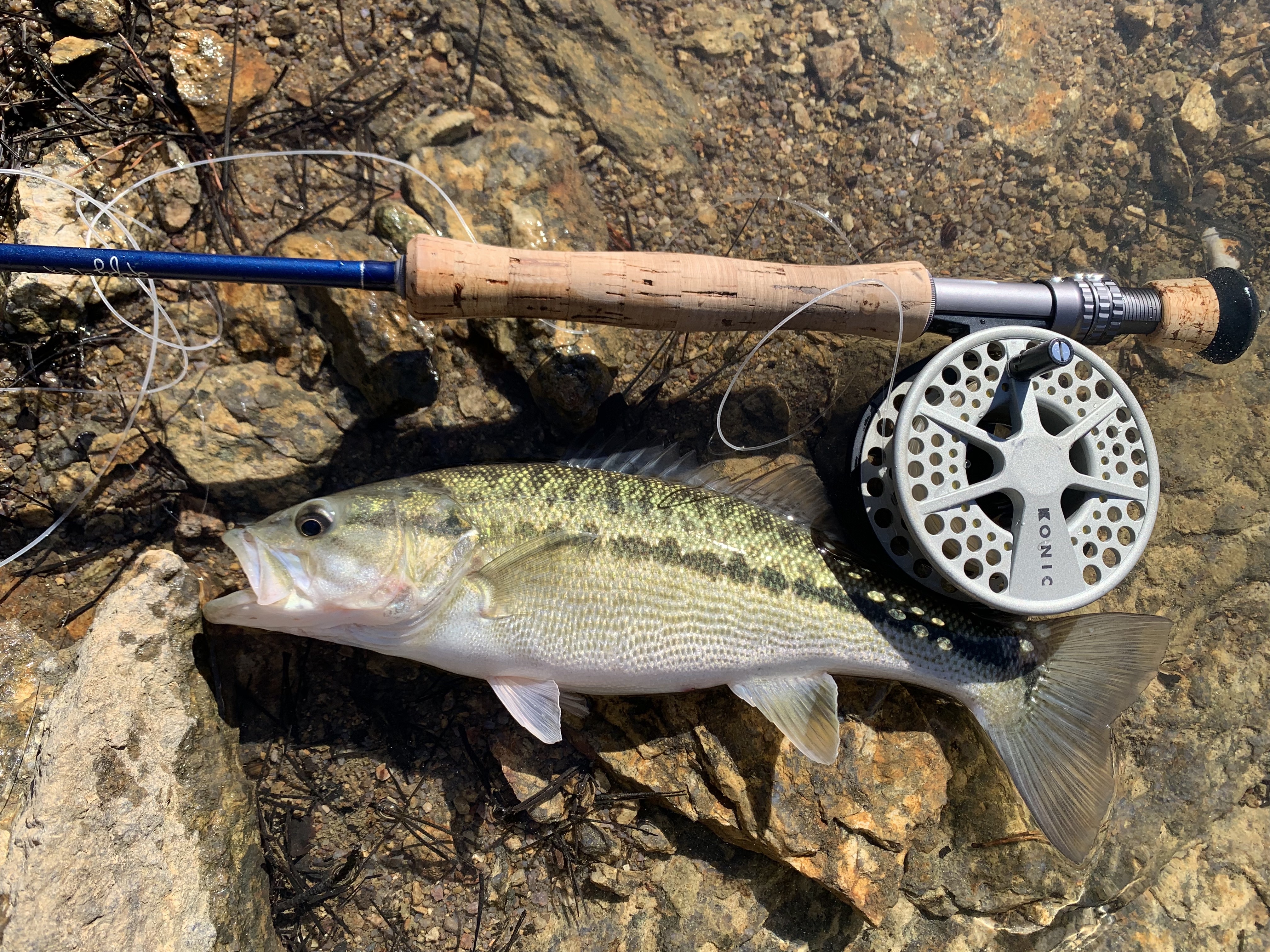
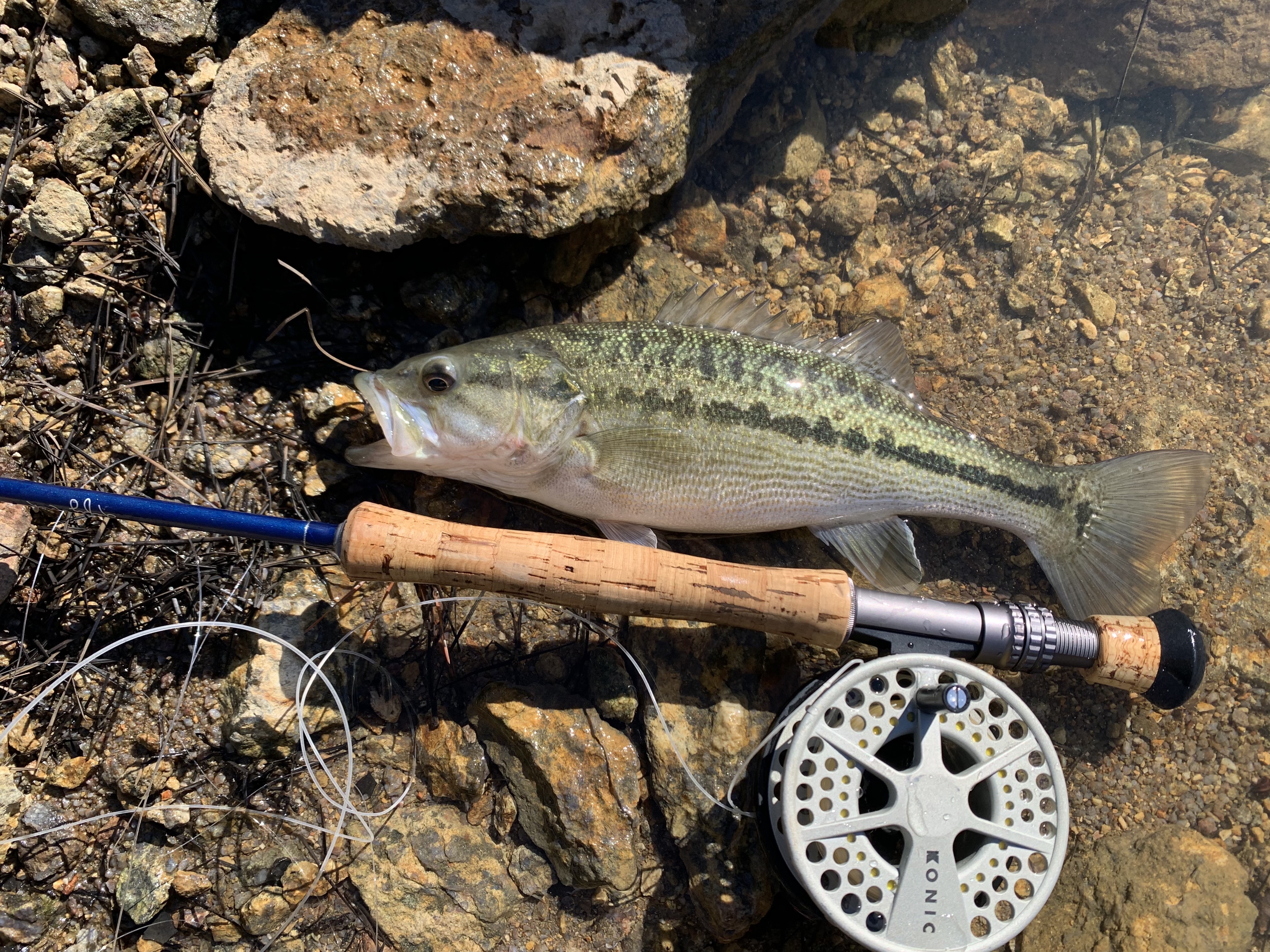
For a quick summary – Georgia has a plethora of bass species. Everything from Largemouth, Spotted, Smallmouth, Shoal, and even Redeye bass. Although the Shoal, Smallmouth, and Redeye bass are a blast, these typically are “warmer” weather fish that are easiest to catch in Georgia during the late spring to early fall months. So for the “colder” weather in winter and early spring, it’s all about the Spotted and Largemouth bass for me in the local lakes.

Let’s start with the winter (I’m talking late November through end of February). After countless hours on the water (with no boat) exploring the best bass fishing lakes that Georgia has to offer, I have found that there are really three (3) keys to success during this season:

  1. Find the rocks and the sun
  2. Smaller flies > bigger flies
  3. Deeper is better

In the winter, Bass are trying to find any spot on a lake where they can collect some warmth. Even if the water temp is just a few degress warmer, these areas are bound to have more fish than the cooler areas of the lakes. I have found that large boulders and rocks majorly assist in providing some “sunning” opportunities for these fish, and would go so far to say that 90+% of the bass I catch in the winter are associated with large rocks, rock ledges, or rocky points on the lakes. In addition to this, I would say that 75+% of my winter bass are caught on smaller flies (no bigger than a size 2 hook) and on intermediate sinking fly lines. These fish really don’t want to put in overtime to eat during the cold, so make the “meal” of a fly as manageable and convenient as possible to them. Get the fly deeper into the strike zone, and make it a bite sized snack.

Here are just some examples of the beautiful bass I have caught in the winter:

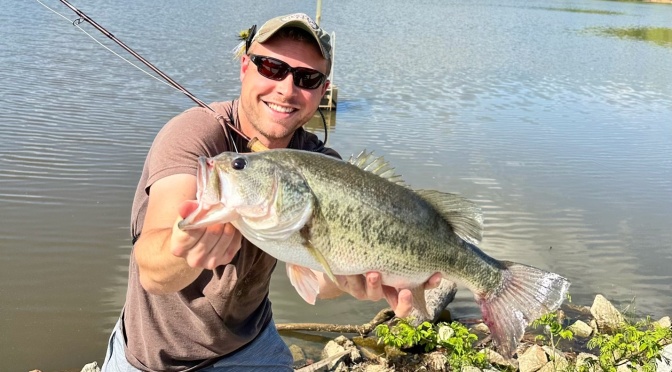
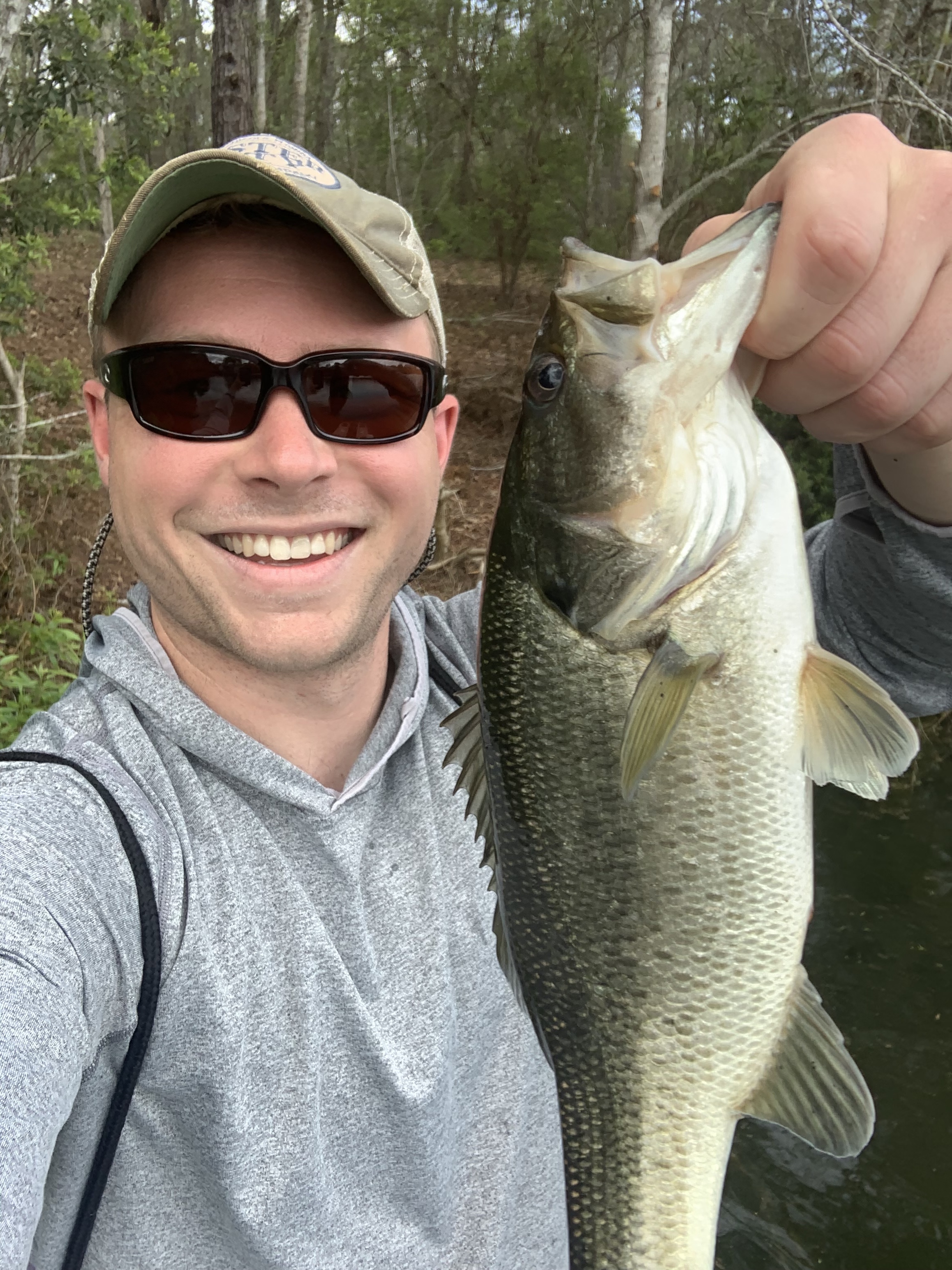
Now for the real fun…SPRING! It is warm, birds are chirping, the sunfish are out again, life is good. Hands down (in my opinion) this is the best time to target bass in Georgia/the south. For those of you that are keen on sight fishing and didn’t want to brave the winter, this is the time for you to dust off the fly rod and get after it. In 2023, the spawn took place earlier than usual it seemed, as I was finding huge Largemouth on their beds by mid-March. With that being said, April was a record for the amount of spawning bass I was seeing, and it actually led to my largest Largemouth I have ever caught (easy 8 pounds).

Joe Petrow – Largemouth Bass

I tried some newer techniques this year for spawning bass that proved to be productive, and some that also overcomplicated the situation. Similar to how I provided three keys for winter bass, I would say these are three keys for spring bass on the fly:

  1. No such thing as too shallow
  2. Don’t be afraid to Super Size that fly selection
  3. If you see one bass, there probably is a second (or third) that you can’t see

This past spring, I caught countless bass sitting in less than 2 feet of water. Moral of the story here is to use caution by the bank…don’t go clunking up right to the water’s edge as there might be a fish sitting there. You don’t need to be a psychopath and crawl up the bank (like some ridiculous trout guides will preach back West), but definitely give yourself 10 feet of space from the bank to monitor the situation. In addition to this, if you do find an aggressive bass that is sitting on a bed (or is just ravenously patrolling an area attacking sunfish), don’t be afraid to tie on a larger fly. Get their attention, strip fast, and hold on. Lastly, I have found that more often that not the bass will school up a bit shallow in the spring. So if you are sight fishing to one bass that is being spooky/difficult, make it a point to throw some blind casts around it as another might be lurking. OR even better, be prepared for another bass to come side-swipe your fly while you are sight fishing a different fish, as this is how I caught my largest Largemouth ever this year (was throwing a larger bunny strip, olive looking leach thing).

Joe Petrow – Largemouth Bass

As always, thanks for the read and hope that this provides some insight into how to get on the bass before the dog days of summer kick in. Tight lines!

Joe

Just a guy and his fly rod taking the road less traveled.